

Data is now the single most valuable asset most UK businesses own, but raw data on its own does very little. The real advantage comes from turning that data into clear, fast, profitable decisions. That is exactly what the country’s leading data analytics companies do, blending engineering, machine learning, and commercial strategy to help organisations grow.
Whether you run a retail brand, a financial services firm, a healthcare provider, or a fast-scaling startup, choosing the right analytics partner can be the difference between guessing and knowing. To make that choice easier, we have rounded up the top 10 data analytics companies in the UK for 2026.
Use this guide to compare specialisms, strengths, and ideal use cases, then shortlist the partners that fit your goals and budget.
When choosing a data analytics partner, businesses should look beyond technical skill to whether the firm understands their goals, data quality challenges, reporting needs, and the tools that turn information into action.
The strongest UK analytics companies typically combine business intelligence dashboard development, governance and data strategy consulting, and expertise in Power BI, Tableau, or Looker Studio with solid data warehouse and engineering services. Many also offer marketing analytics and GA4 implementation, predictive analytics and AI, workflow and reporting automation, and cloud data platform support, all backed by clear communication, training, and proven experience across multiple industries.
Vidi Corp publishes this guide and sits at number one in it. We have tried to keep it fair by judging every company against the same criteria, and by linking to public evidence rather than asking you to take claims on faith.
The criteria were UK market presence, technical expertise we could verify, public evidence of delivery, and a spread across the four models above so different types of buyer are represented. Where a firm publishes named case studies, we point to them. Where it does not, we say so rather than dressing up a services page as proof.
One note on the pricing column. Anything marked Clutch is a self-reported estimate from that directory, not a rate the company publishes itself. Anything marked published is set by the company, or in Kubrick’s case listed in a public government framework. We have kept that difference visible because it tells you how much weight to put on the number.
| Rank | Company | Best Known For |
|---|---|---|
| 1 | Vidi Corp | Power BI, Looker Studio, GA4, marketing analytics, automation, Power Platform and business intelligence dashboards |
| 2 | Dufrain | Data strategy, data governance, data engineering, business intelligence and AI driven data transformation |
| 3 | Kubrick Group | Data consulting, AI, cloud transformation, analytics delivery and data talent development |
| 4 | Adatis, part of Telefónica Tech UK and Ireland | Microsoft Fabric, Azure data platforms, Power BI and enterprise analytics |
| 5 | Datalytyx | Snowflake, Databricks, DataOps, cloud data platforms, data engineering and machine learning support |
| 6 | Analytics8 | Data strategy, business intelligence, analytics consulting, reporting and dashboard development |
| 7 | Deloitte UK AI and Data | AI consulting, advanced analytics, data transformation, automation and enterprise reporting |
| 8 | KPMG UK Data and Analytics | Data analytics, AI advisory, risk analytics, governance and regulatory insight |
| 9 | Capgemini UK | Data transformation, AI, cloud analytics, data engineering and automation |
| 10 | Experian UK | Credit risk analytics, customer analytics, identity, fraud, marketing data and decisioning tools |
Website – https://vidi-corp.com/
Vidi Corp ranks as one of the leading data analytics companies in the UK for businesses that want practical, scalable and performance-driven analytics solutions. The company specialises in business intelligence, data analytics, dashboard development, marketing analytics, Power Platform consulting and automation.
Vidi Corp is particularly strong for organisations that want to move from manual reporting to automated insights. Its services cover Power BI dashboards, Looker Studio reports, Google Analytics 4 consulting, Google Tag Manager implementation, data warehouse development, Power Automate workflows, Power Apps solutions, SharePoint consulting and robotic process automation.
What makes Vidi Corp stand out is its ability to combine analytics with business process automation. Instead of only building reports, the company helps businesses create connected systems where data collection, reporting, workflow automation and decision making work together.
| Vidi Corp | Analytics and automation from one team |
|---|---|
| Best for | SMEs, agencies, ecommerce, professional services, public sector and mid-market that want dashboards and automation together |
| Delivery model | Combined: connectors and software, build projects, and ongoing support |
| Expertise | Power BI, Looker Studio, GA4, Google Tag Manager, Power Platform, data warehousing, RPA |
| Evidence | Ranked #1 business intelligence consultancy worldwide by G2, own case studies and dashboard portfolio, proprietary data connectors, Clutch profile |
| Pricing | $100 per hour; $750 min project |
| Less suited to | Buyers who want a global brand name at board level, or a software licence with no build attached |
Why Choose Vidi Corp?
Vidi Corp is a strong choice for businesses that want dashboards, analytics and automation under one roof. The company is suitable for SMEs, agencies, ecommerce brands, professional services firms, public sector teams and enterprises looking for accurate reporting and better operational visibility.
With a practical consulting model and a strong focus on measurable business outcomes, Vidi Corp helps companies transform complex data into clear insights, automated workflows and smarter decisions.
Website – https://www.dufrain.co.uk/
Dufrain is a well-known UK data consultancy focused on data management, business intelligence, AI, advanced analytics and data transformation. The company works with organisations that need strong data foundations before scaling analytics or AI initiatives.
Dufrain helps businesses improve data quality, modernise data platforms, strengthen governance and build analytics solutions that support growth. Its expertise spans data strategy, data architecture, data engineering, data governance, migration, BI reporting and AI-enabled analytics.
| Dufrain | Data foundations and governance |
|---|---|
| Best for | Mid-market to enterprise needing strong data foundations and governance, especially in regulated sectors |
| Delivery model | Implementation consultancy and ongoing managed services |
| Expertise | Data strategy, governance, data engineering, Azure, Power BI, Tableau, Snowflake |
| Evidence | Published client case studies including NatWest Rooster Money, Atom Bank, Carnival UK and Ultimate Finance |
| Pricing | Clutch: est. $100 to $149 per hour |
| Less suited to | Small-business self-serve dashboards or standalone marketing analytics |
Best For
Dufrain is ideal for organisations that need enterprise-grade data foundations, especially in industries where governance, trust and scalability are essential.
Website – https://kubrickgroup.com/
Kubrick Group is a UK data and AI consultancy focused on helping organisations build modern analytics capability. The company combines consulting delivery with talent development, making it a strong option for enterprises that want to improve both project outcomes and internal data skills.
Kubrick works across data, AI, cloud and transformation projects. Its consultants support organisations with data engineering, analytics delivery, AI adoption, cloud platforms and long-term capability building.
| Kubrick Group | Delivery plus embedded consultants |
|---|---|
| Best for | Large organisations wanting project delivery and internal capability building together |
| Delivery model | Consulting through trained, embedded consultants |
| Expertise | Data engineering, AWS and Azure, Snowflake, Databricks, machine learning |
| Evidence | Published case studies with quantified outcomes, including a reported 14 million dollar aircraft maintenance saving and a 40 per cent uplift in marketing channel revenue |
| Pricing | Published (UK government framework): day rates from around £385 to £1,375 by role |
| Less suited to | Small, one-off dashboard builds, or teams that cannot host embedded consultants |
Best For
Kubrick Group is well-suited to large organisations that want a mix of consulting support and embedded data talent to accelerate transformation programmes.
Website: https://telefonicatech.uk/solutions/data-ai/
Adatis, now part of Telefónica Tech UK and Ireland, is a respected data analytics and cloud data platform specialist. The company is known for Microsoft focused analytics solutions, including Microsoft Fabric, Azure Data Platform and Power BI.
Adatis helps organisations design and implement secure data platforms, reporting solutions and enterprise scale analytics environments. Its strength lies in combining Microsoft cloud technology with data engineering, BI and AI capability.
| Adatis (Telefónica Tech) | Microsoft data platform specialist |
|---|---|
| Best for | Organisations invested in the Microsoft stack, particularly Fabric, Azure and Power BI |
| Delivery model | Implementation consultancy within a larger technology group |
| Expertise | Microsoft Fabric, Azure Data Platform, Power BI, data lakes |
| Evidence | Microsoft Featured Fabric Partner with Azure Expert status, invited to the Microsoft Fabric private preview, with published Fabric delivery case studies |
| Pricing | Clutch: minimum project size from $10,000 |
| Less suited to | Snowflake or AWS-centred stacks, where its Microsoft focus counts for less |
Best For
Adatis is a strong choice for organisations already invested in the Microsoft ecosystem and looking to modernise analytics with Microsoft Fabric, Azure and Power BI.
Website: https://www.datalytyx.com/
Datalytyx is a UK based data services provider focused on modern data platforms, data engineering, analytics and machine learning. The company works with leading cloud data technologies and supports organisations that need faster access to reliable data.
Datalytyx is recognised for its work with Snowflake, Databricks, Talend and DataOps approaches. Its services help businesses reduce time to insight, improve governance and support analytics at scale.
| Datalytyx | Snowflake and Talend specialist |
|---|---|
| Best for | Organisations standardising on Snowflake, Databricks or Talend |
| Delivery model | Platform-specialist implementation and managed services |
| Expertise | Snowflake, Databricks, Talend, DataOps, data engineering |
| Evidence | Snowflake Elite Partner and first Snowflake services partner in EMEA, plus Platinum Talend partner, with named clients including Informa Markets, Stonegate Group and BOC |
| Pricing | Clutch: est. $150 to $199 per hour |
| Less suited to | Work outside the Snowflake or Talend stack, where its edge narrows |
Best For
Datalytyx is ideal for organisations that need cloud data platform expertise, especially where Snowflake, Databricks and modern data engineering are central to the analytics strategy.
Website: https://analytics8.co.uk/
Analytics8 is a specialist data and analytics consulting company with a UK presence. The company focuses on helping organisations use data to make smarter decisions through analytics strategy, business intelligence and reporting.
Analytics8 works with businesses to define data strategy, improve reporting systems and turn fragmented data into useful insights. Its consulting approach is suitable for organisations that need clear analytics roadmaps as well as technical delivery.
| Analytics8 | Vendor-independent consultancy |
|---|---|
| Best for | Organisations wanting vendor-neutral strategy and BI rather than a single-platform specialist |
| Delivery model | Vendor-independent consultancy |
| Expertise | Data strategy, business intelligence, data management, governance |
| Evidence | Consultancy since 2002 with a stated 800-plus clients, and published case studies across retail, financial services and manufacturing |
| Pricing | Clutch: minimum project size from $75,000 |
| Less suited to | GA4 or marketing analytics specialisms, and buyers wanting a large UK-based team |
Best For
Analytics8 is a good fit for businesses that want specialist analytics consulting rather than a broad generalist technology provider.
Website: https://www.deloitte.com/uk/
Deloitte UK is one of the largest professional services firms offering artificial intelligence, data and analytics consulting. Its AI and Data services help large organisations transform data into insight, automate processes and improve decision making at scale.
Deloitte combines consulting, technology, industry expertise and transformation delivery. Its services are especially relevant for enterprises with complex analytics requirements, regulatory considerations and large scale change programmes.
| Deloitte UK | Enterprise consulting |
|---|---|
| Best for | Large enterprises and public sector with complex, regulated programmes |
| Delivery model | Enterprise consulting and transformation delivery |
| Expertise | AI, advanced analytics, enterprise data platforms, automation |
| Evidence | Big Four firm delivering large-scale enterprise and public-sector analytics and AI programmes, and recognised in analyst evaluations of the sector |
| Pricing | Not published, custom quote |
| Less suited to | Smaller businesses, given enterprise pricing and scale |
Best For
Deloitte UK is best suited for large enterprises and public sector organisations that need strategic consulting, complex programme delivery and enterprise scale data transformation.
Website: https://kpmg.com/uk/
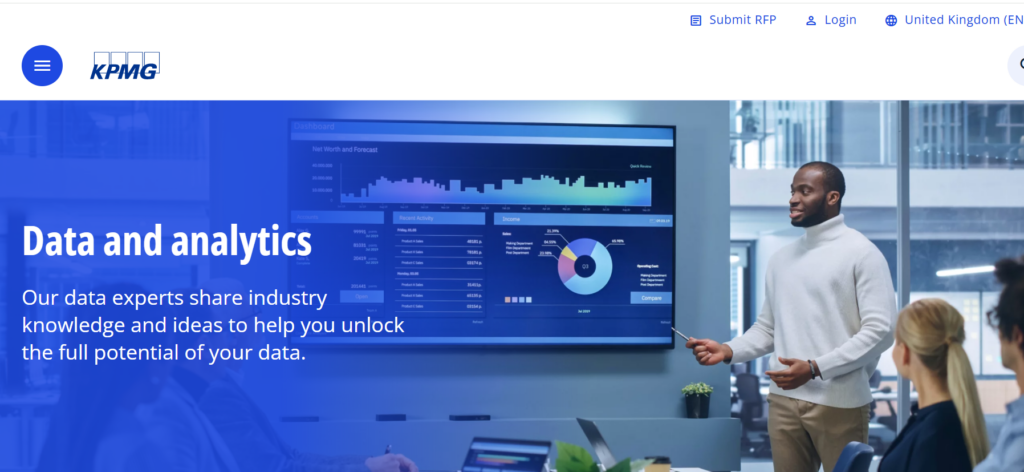
KPMG UK provides data, analytics, AI and technology consulting services for businesses that need trusted insights, regulatory awareness and enterprise transformation support. The firm helps clients use data to manage risk, improve performance and identify growth opportunities.
KPMG is particularly relevant for organisations in financial services, public sector, healthcare, infrastructure and regulated industries where analytics must align with governance, compliance and business strategy.
| KPMG UK | Analytics with governance |
|---|---|
| Best for | Regulated industries needing analytics combined with governance and assurance |
| Delivery model | Advisory and consulting |
| Expertise | Risk analytics, data governance, regulatory analytics, business intelligence |
| Evidence | Big Four firm with documented strength in risk, governance and regulatory analytics for regulated sectors |
| Pricing | Not published, custom quote |
| Less suited to | Small-business reporting, which sits outside its enterprise focus |
Best For
KPMG UK is a strong choice for organisations that need analytics expertise combined with governance, assurance and regulatory understanding.
Website: https://www.capgemini.com/
Capgemini UK is a major technology consulting company offering data, AI, cloud and analytics services. The company supports enterprise clients with large scale data transformation, cloud analytics platforms, AI adoption and digital innovation.
Capgemini is a good fit for organisations looking for broad technical capability across data engineering, business intelligence, automation, artificial intelligence and managed services.
| Capgemini UK | Global systems integrator |
|---|---|
| Best for | Large organisations needing end-to-end transformation at global scale |
| Delivery model | Systems integration and managed services |
| Expertise | Data engineering, cloud analytics, AI, enterprise architecture |
| Evidence | Global systems integrator delivering large-scale data engineering and managed services, with partnerships across Microsoft, AWS and Google Cloud |
| Pricing | Not published, custom quote |
| Less suited to | Smaller projects, where its programme scale is more than needed |
Best For
Capgemini UK is best for large organisations that need end to end technology transformation supported by global delivery capability.
Website: https://www.experian.co.uk/
Experian is one of the most recognised names in data, analytics and credit information services. In the UK, Experian supports businesses with customer data, credit risk analytics, identity verification, marketing insights and decisioning tools.
While Experian is different from a traditional analytics consultancy, it remains a major player in the UK data analytics market because of its data assets, decisioning platforms and analytics products.
| Experian UK | Data and decisioning products |
|---|---|
| Best for | Organisations buying credit, identity, fraud or marketing data and decisioning |
| Delivery model | Data and decisioning products, subscription and platform |
| Expertise | Credit risk, identity and fraud, marketing data, decisioning |
| Evidence | Publicly documented data products and decisioning platforms used across UK financial services |
| Pricing | Published product pricing, business credit subscriptions from around £199 per year, enterprise deployments on quote |
| Less suited to | Custom dashboards or BI implementation, which it does not build |
Best For
Experian UK is ideal for organisations that need data products, credit analytics, customer insight and risk-based decisioning solutions.
The right analytics partner depends on your business size, data maturity, existing technology stack and goals. A company looking for GA4 tracking and Power BI dashboards will need a different partner from an enterprise planning a large cloud data platform migration.
When shortlisting UK data analytics companies, consider the following factors:
1. Define Your Analytics Goals
Start by identifying the business problem. Do you need better dashboards, customer analytics, marketing attribution, AI forecasting, data warehousing, workflow automation or governance? Clear goals make it easier to choose the right provider.
2. Review Technology Expertise
Look for companies with experience in the tools your organisation already uses. Common platforms include Power BI, Looker Studio, Tableau, Microsoft Fabric, Azure, Snowflake, Databricks, Google Analytics, BigQuery and AWS.
3. Check Industry Experience
A data analytics company with experience in your sector will understand your KPIs, reporting challenges and compliance needs faster.
4. Evaluate Communication and Training
Good analytics partners do more than deliver dashboards. They explain insights clearly, train teams and help users adopt data driven decision making.
5. Consider Scalability
Your analytics needs will grow. Choose a company that can support future requirements such as automation, AI, data governance and advanced analytics.
UK businesses are operating in a fast-moving and highly competitive environment. Customer expectations are rising, digital channels are producing more information than ever, and companies are under pressure to make quicker, smarter and more cost-effective decisions. In this environment, data analytics is no longer just a technical function. It has become a core business capability.
Data analytics helps UK businesses understand what is happening across their operations, why certain trends are emerging and what actions should be taken next. Instead of relying on guesswork, outdated spreadsheets or disconnected reports, companies can use analytics to make decisions based on accurate, timely and meaningful insights.
From small businesses and ecommerce brands to financial services firms, healthcare providers, professional services companies and public sector organisations, data analytics supports better planning, stronger performance and improved customer experiences.
1. Improve Marketing Performance
Marketing teams need to know which campaigns are generating traffic, leads, enquiries, sales and revenue. Data analytics helps businesses track campaign performance across channels such as Google Ads, social media, email marketing, organic search and paid media.
With tools such as Google Analytics 4, Looker Studio, Power BI and marketing dashboards, businesses can see which activities deliver the highest return on investment. This allows teams to reduce wasted spend, improve audience targeting and focus on the channels that produce measurable results.
For UK businesses competing in crowded digital markets, marketing analytics can make the difference between spending blindly and investing confidently.
2. Reduce Manual Reporting
Many organisations still rely on manual spreadsheets, repeated data exports and time-consuming monthly reports. This creates delays, increases the risk of human error and prevents teams from acting quickly.
Data analytics solutions automate reporting by connecting data sources directly into dashboards and business intelligence platforms. Instead of manually collecting information from different systems, teams can access live or regularly updated reports in one place.
This saves time, improves accuracy and allows employees to focus on analysis and decision making rather than repetitive reporting tasks.
3. Increase Operational Efficiency
Operational efficiency is one of the biggest benefits of data analytics. By analysing internal processes, businesses can identify bottlenecks, delays, underused resources and areas where costs can be reduced.
For example, a logistics company can analyse delivery times, route performance and fuel usage. A retailer can monitor stock levels, sales trends and supplier performance. A service business can track project delivery, team workload and client profitability.
These insights help UK businesses streamline operations, reduce waste and improve productivity across departments.
4. Track Sales and Customer Behaviour
Understanding customers is essential for growth. Data analytics allows businesses to track how customers find them, what products or services they are interested in, how they move through the buying journey and why they convert or drop off.
Sales teams can use analytics to monitor pipeline performance, lead quality, conversion rates, average order value and customer lifetime value. Ecommerce businesses can use ecommerce performance analytics to analyse product sales, abandoned baskets, repeat purchases and customer segments.
By understanding customer behaviour more clearly, businesses can improve sales strategies, personalise communication and create better buying experiences.
5. Improve Forecasting and Planning
Accurate forecasting helps businesses prepare for future demand, manage budgets and allocate resources effectively. Data analytics allows companies to use historical data, trends and patterns to make better predictions.
For example, businesses can forecast sales demand, website traffic, staffing needs, stock requirements, cash flow and customer churn. These insights help leaders plan more confidently and reduce the risk of unexpected problems.
In uncertain economic conditions, forecasting is especially valuable for UK businesses that need to remain agile and financially resilient.
6. Identify Risks Earlier
Data analytics can help businesses spot risks before they become serious problems. By monitoring performance indicators, unusual patterns and early warning signals, companies can respond faster.
This is useful across many areas, including finance, operations, cybersecurity, compliance, customer service and supply chain management. For example, analytics can help identify declining customer satisfaction, rising costs, unusual transactions, missed targets or operational delays.
Early risk detection gives businesses more time to investigate issues, take corrective action and protect performance.
7. Build Better Customer Experiences
Customers expect fast, personalised and consistent experiences across every touchpoint. Data analytics helps businesses understand customer needs, preferences, pain points and satisfaction levels.
By analysing website behaviour, support tickets, purchase history, feedback and engagement data, companies can identify where the customer experience can be improved. This may include simplifying the buying journey, improving response times, personalising offers or reducing friction in digital services.
Better customer experiences often lead to higher retention, stronger loyalty and increased revenue.
8. Support AI and Automation
Artificial intelligence and automation depend on reliable data. Before businesses can use AI effectively, they need clean, organised and accessible data. Data analytics provides the foundation for these technologies.
With the right analytics infrastructure, UK businesses can automate reporting, build predictive models, use AI-powered insights and connect it all with enterprise process automation. This can help teams work faster, reduce repetitive tasks and make more proactive decisions.
Companies that invest in analytics today are better prepared to adopt AI and automation in the future.
9. Measure Business Performance Accurately
Every business needs to understand whether it is moving in the right direction. Data analytics helps companies define and track key performance indicators across departments.
Data analytics helps companies define and track key performance indicators across departments, often through KPI dashboards that keep the numbers visible in one view. These KPIs may include revenue growth, profit margins, lead conversion rate, customer acquisition cost, customer retention, employee productivity, stock turnover, service levels and campaign ROI.
When performance data is visible and easy to understand, leaders can quickly identify what is working, what needs improvement and where resources should be focused.
10. Make Confident Strategic Decisions
The biggest value of data analytics is its ability to support better decision making. Business leaders need reliable insights when launching new products, entering new markets, setting budgets, hiring staff, investing in technology or changing strategy.
Analytics gives decision makers a clearer view of business performance, market trends and customer behaviour. This reduces uncertainty and helps organisations make decisions based on evidence rather than assumptions.
For UK businesses looking to grow, compete and adapt, data analytics provides the clarity needed to make confident strategic decisions.
The UK data analytics market is evolving quickly as businesses look for faster, smarter and more reliable ways to use their data. Companies are no longer satisfied with static reports that only show past performance. They want real time insights, automated dashboards, AI ready data platforms and analytics solutions that directly support growth, efficiency and better decision making.
As more organisations invest in digital transformation, data analytics is becoming central to business strategy. From SMEs and ecommerce brands to financial services firms, healthcare providers, public sector organisations and enterprise companies, UK businesses are using analytics to improve visibility, reduce manual work and create stronger customer experiences.
Below are some of the most important data analytics trends shaping the UK market.
1. Growth of Microsoft Fabric and Modern BI Platforms
Microsoft Fabric is becoming increasingly important for UK businesses that already use Microsoft tools such as Power BI, Azure, Excel, Teams and Microsoft 365. It brings data engineering, data science, real time analytics, data warehousing and business intelligence into one connected environment.
This trend is important because many organisations want simpler, more integrated analytics platforms. Instead of managing separate tools for storage, transformation, modelling and reporting, businesses are looking for unified systems that make data easier to access and manage.
Modern BI platforms are also becoming more user friendly. Business teams want dashboards that are easy to understand, interactive and accessible across departments. This is driving demand for consultants who can build scalable BI solutions using platforms such as Power BI, Looker Studio, Tableau and Microsoft Fabric.
For UK businesses, the growth of modern BI platforms means faster reporting, better collaboration and stronger data driven decision making.
2. Increased Adoption of Power BI and Looker Studio
Power BI and Looker Studio continue to be widely adopted by UK businesses because they make reporting more visual, accessible and cost effective. These tools help companies turn raw data into dashboards that show sales, marketing performance, finance metrics, customer behaviour and operational results.
Power BI is especially popular with organisations already using Microsoft products. It allows businesses to build interactive reports, connect multiple data sources and share insights across teams. Looker Studio is often used for marketing analytics, website reporting, GA4 dashboards and campaign performance tracking.
The demand for Power BI consultants and Looker Studio specialists is increasing as businesses move away from static spreadsheets and manual reports. Companies want dashboards that update automatically and give teams instant access to the numbers that matter.
This trend is particularly useful for SMEs, agencies, ecommerce companies and service based businesses that need clear reporting without unnecessary complexity.
3. Stronger Focus on Data Governance and Data Quality
As businesses collect more data, data quality has become a major priority. Poor quality data can lead to inaccurate reporting, weak forecasting, wasted marketing spend and poor business decisions.
UK organisations are now paying closer attention to data governance, which includes how data is collected, stored, accessed, protected and used. Businesses want to know that their reports are based on accurate, consistent and trusted information.
Data governance is especially important for industries such as finance, healthcare, insurance, education and the public sector, where compliance, privacy and accuracy are essential.
Strong data governance helps businesses avoid duplicate records, inconsistent definitions, missing data and unreliable dashboards. It also creates a stronger foundation for AI, automation and advanced analytics.
In short, businesses are realising that better analytics starts with better data quality.
4. More Demand for GA4 and Marketing Analytics
Marketing analytics has become one of the fastest growing areas of data analytics in the UK. Since the move from Universal Analytics to Google Analytics 4, many businesses have needed support with GA4 setup, event tracking, conversion tracking, reporting and dashboard development.
GA4 gives businesses more flexibility in tracking user behaviour, but it can also be more complex to configure and interpret. This has increased demand for specialists who understand GA4, Google Tag Manager, Looker Studio and marketing attribution.
UK businesses want to understand which marketing channels generate leads, sales and revenue. They need to measure paid search, organic traffic, social media, email campaigns, referrals and ecommerce activity in one clear reporting view.
Marketing analytics helps businesses reduce wasted ad spend, improve campaign performance and make better decisions about where to invest their budget.
For companies competing online, strong GA4 and marketing analytics reporting is now essential.
5. Expansion of AI and Predictive Analytics
Artificial intelligence is changing the way businesses use data. UK organisations are increasingly interested in predictive analytics, machine learning and AI powered insights that help them move beyond basic reporting.
Traditional dashboards show what has already happened. Predictive analytics helps businesses understand what is likely to happen next. This can include forecasting sales, predicting customer churn, identifying high value leads, estimating demand or detecting unusual activity.
AI is also being used to speed up data analysis, automate recommendations and help teams uncover trends that may not be obvious in standard reports.
However, AI depends on reliable data. Businesses that want to use AI successfully need strong data foundations, clean datasets and well structured analytics systems.
This is why many UK companies are now investing in data warehouses, governance and analytics infrastructure before scaling AI solutions.
6. Automation of Reporting Workflows
Manual reporting is one of the biggest challenges for many businesses. Teams often spend hours exporting data, copying information into spreadsheets, formatting reports and sending updates to stakeholders.
Reporting automation solves this problem by connecting data sources directly to dashboards and scheduled reports. With automation, businesses can reduce repetitive tasks and ensure that decision makers always have access to updated information.
Tools such as Power BI, Looker Studio, Power Automate and cloud data platforms are helping businesses automate reporting workflows across sales, marketing, finance, operations and customer service.
This trend is especially valuable for growing companies that need to save time and reduce errors. Automated reporting allows teams to focus less on preparing data and more on understanding what the data means.
7. Greater Use of Cloud Data Warehouses
Cloud data warehouses are becoming more common as UK businesses need better ways to store, manage and analyse large volumes of data. Platforms such as Snowflake, BigQuery, Azure Synapse, Databricks and Amazon Redshift help companies bring data from multiple systems into one central environment.
A cloud data warehouse allows businesses to combine information from websites, CRM systems, finance tools, marketing platforms, ecommerce systems and operational databases. This creates a clearer and more complete view of business performance.
Cloud data warehouses are also scalable, which means they can grow as the business grows. They support advanced analytics, AI, machine learning and real time reporting more effectively than traditional spreadsheet based processes.
For businesses dealing with complex data, cloud data warehousing is becoming a key part of modern analytics strategy.
8. Rising Demand for Self Service Analytics
Self service analytics allows non technical users to explore data and generate insights without always depending on data teams. This is becoming increasingly important as more departments want direct access to performance information.
Sales teams want pipeline dashboards. Marketing teams want campaign reports. Finance teams want revenue visibility. Operations teams want productivity metrics. Leadership teams want executive summaries.
Self service analytics gives users the ability to filter dashboards, explore trends and answer business questions quickly. This improves speed, reduces bottlenecks and encourages a stronger data culture across the organisation.
However, self service analytics must be supported by good governance. Businesses need clear definitions, secure access controls and trusted datasets so users are working with accurate information.
When done properly, self service analytics helps more people make better decisions using data.
9. Integration of Analytics with Business Apps
Another major trend is the integration of analytics with everyday business applications. Instead of viewing dashboards as separate tools, businesses want insights embedded directly into the systems their teams already use.
This may include CRM systems, finance platforms, project management tools, ecommerce platforms, HR systems, customer support software and Microsoft 365 apps.
For example, a sales manager may want pipeline analytics inside a CRM. A finance team may want automated reporting connected to accounting software. A marketing team may want GA4 and advertising data integrated into a single dashboard.
Integration makes analytics more useful because insights appear where decisions are made. It also reduces the need to switch between multiple platforms and improves workflow efficiency.
This trend is closely connected to automation, Power Platform solutions and modern business intelligence systems.
10. Focus on Measurable Return on Investment
Businesses are becoming more focused on the commercial value of data analytics. They do not want dashboards for the sake of dashboards. They want analytics projects that improve performance, save time, increase revenue or reduce costs.
This means data analytics companies in the UK are being asked to show clear business outcomes. Clients want to understand how a dashboard, data warehouse, automation project or AI solution will contribute to measurable results.
Examples of analytics return on investment include reducing manual reporting time, improving marketing ROI, increasing sales conversion rates, reducing customer churn, improving stock management or identifying cost saving opportunities.
This trend is positive because it encourages analytics projects to stay closely aligned with business goals.
The most successful analytics solutions are not just technically impressive. They are practical, easy to use and directly connected to business performance.
The UK is home to a deep pool of world class data analytics talent, and the ten companies above represent some of the strongest options available in 2026. From enterprise decision intelligence to applied AI and customer data, there is a partner here for almost every need.
If you want a single, capable partner to guide you across the entire data journey, from strategy to dashboards to AI, Vidi Corp is our recommended starting point. Whichever firm you choose, the key is to focus on measurable outcomes and a partner that truly understands your business.
There is no single answer for every business, but Vidi Corp is our top overall pick for 2026 thanks to its end to end approach across data strategy, engineering, BI, and AI. The best choice for you depends on your goals, sector, and budget.
Pricing varies widely depending on scope, from short consulting engagements to long term platform builds. Many firms offer tiered options, so it is worth requesting a tailored quote based on your specific requirements.
It depends on your maturity and ambitions. Some organisations prefer to build internal capability, while others want a specialist partner to move quickly. Several firms, including Kubrick and full stack partners like Vidi Corp, can help you do both over time.
Almost every sector benefits, but retail, financial services, healthcare, utilities, manufacturing, and the public sector tend to see particularly strong returns from well executed analytics.


