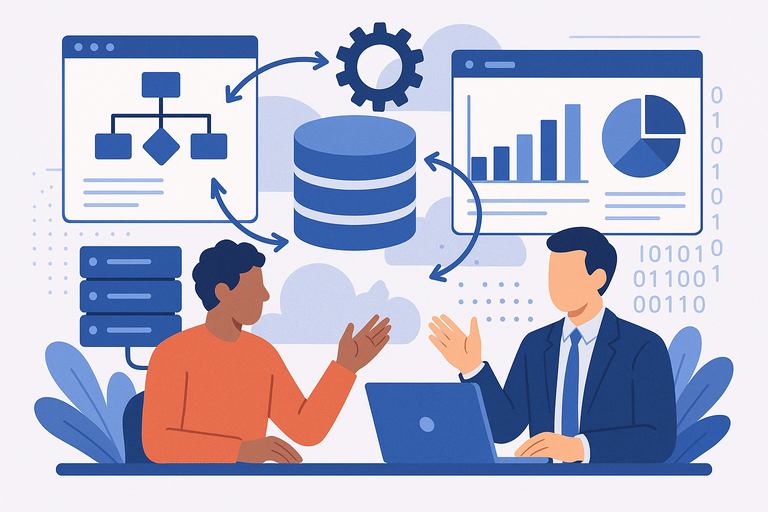
Legacy systems often create fragmented information, slow reporting cycles and excessive manual effort. Turn fragmented legacy data into a scalable, secure and AI-ready environment with Vidi Corp’s data modernization services.
We modernize data platforms, warehouses, architecture and reporting on Microsoft Azure, Fabric and the Power Platform, helping businesses improve data access, automate manual processes and make faster decisions.
1000+
Completed
projects
600+
Happy
clients
20k+
Hours
worked





As a leading data modernization consultants, we offer end-to-end data solutions, from the first assessment through to a fully working platform. Most engagements draw on a combination of the capabilities below.

We design and build modern data platforms on Microsoft Azure, typically using Microsoft Fabric, Azure SQL and Azure Data Factory. That means one governed place where your data lands, gets cleaned and becomes available to every downstream tool, instead of a patchwork of exports and one-off integrations.

Ageing on-premise warehouses are one of the most common reasons companies call us. Our datawarehouse consulting services migrate and redesign them for the cloud, restructuring the model so queries that used to time out now run in seconds.
If you are a Microsoft house, you will hear the phrase “data estate” a lot. It means everything: databases, files, applications and the pipelines between them. We assess your full data estate and produce a pragmatic modernization roadmap, prioritised by business impact rather than technical tidiness.
Sometimes the data is fine but the architecture around it is not. We redesign data models, pipelines and integration patterns so the platform is easier to maintain, cheaper to run and ready for whatever you build next.

This is where the value becomes visible. Our Power BI consultants replace static Excel reports and legacy BI tools with modern Power BI reporting, built on the newly modernized platform. If your team spends more time producing reports than reading them
Vidi Corp helped us establish a cloud-based relational database environment on Microsoft Azure, connected to our critical systems through secure REST APIs. The new architecture reduced our data silos from six systems to one centralized database and cut manual data consolidation by 95%. Reporting that previously took 48 hours now takes under five minutes, while automated feeds reduced data-entry errors by 80%. The combination of centralized data and real-time analytics has helped us make strategic decisions around 40% faster.
Travis Kelley
CEO, War Room Operations

We needed to automate procurement reporting from SAP Ariba while retaining the accuracy of our existing Power BI environment. Vidi Corp built an automated Python extraction process that sends our SAP Ariba data into an Azure SQL database we own, then rebuilt the report around the new data structure. The automated extraction now saves us around five hours every month and lets us refresh the report more frequently. We also have a reusable data foundation for additional automations and Power BI reporting.
Lubna Mousa
Senior Global Procurement Manager, Mercy Corps
Vidi Corp created a continually refreshing Azure SQL environment that centralized transactions, customers, products and lab information from our point-of-sale system. They converted our existing data flows into database processes that incrementally add new records and kept our Power BI workbook operating correctly after the transition. Our data can now refresh on a schedule, with some records designed to update as frequently as every five minutes. The team delivered the project quickly and brought in additional expertise whenever complex issues required it.
COO & Co-Owner, Cannabis Retailer





Bring critical information together so reporting, analytics, and operational workflows rely on consistent data rather than disconnected departmental sources.
Automated pipelines and modern analytics reduce the time teams spend extracting, combining and validating information before it can be used.
Modern data architectures can feed Power BI and other analytics environments with more current information, giving leadership clearer visibility into performance.
Create the structured, accessible and governed data foundation required to make AI initiatives more practical.
Modernization programs succeed when technology decisions are connected to measurable business priorities. Our delivery process is designed to reduce unnecessary complexity and move from assessment to value creation in clear stages.

Data Modernization Consultation
We begin by reviewing your current data estate, including databases, warehouses, integrations, reporting systems, manual processes and business requirements.
The assessment identifies legacy constraints, data silos, performance issues and high-value modernization opportunities. We then establish priorities around business impact rather than modernizing technology simply for the sake of change.

Architecture & Technology Design
Our team designs the target architecture, including data storage, ingestion, transformation, integration, governance and analytics layers.
We select technologies based on your existing Microsoft environment, expected data volumes, reporting requirements and future roadmap. The objective is an architecture that is scalable without being unnecessarily complicated.

Migrate and Build
We migrate priority workloads, develop the required databases and data pipelines, and rebuild inefficient integration processes.
Validation is built into delivery so migrated information can be checked against source systems and existing reports before teams transition to the new environment.

Automate
Once the foundation is in place, we automate recurring data extraction, transformation and refresh processes.
This reduces dependency on manual exports and repetitive administrative tasks while allowing Power BI dashboards and operational systems to work with more current information.

Ongoing Optimization & Support
Modernization does not end when the platform goes live.
We review performance, data quality, refresh processes and evolving business requirements to identify further improvements. The environment can then expand to support additional departments, systems, analytics and AI use cases.
Data modernization is the process of improving legacy data infrastructure, architecture, integration and analytics so information can be stored, processed and used more efficiently. It often includes cloud migration, database modernization, data warehouse modernization, automated pipelines, improved governance and modern BI reporting.
The ultimate goal is to create a scalable data foundation that supports faster reporting, automation, analytics and future AI initiatives.
Data migration focuses primarily on moving data from one location, platform or system to another. Data modernization goes further by improving the architecture, integrations, automation, storage and analytical processes around that data.
A modernization project may therefore include migration, but a migration project does not automatically modernize the wider data environment.
The timeline depends on the number of source systems, complexity of the existing architecture, data volumes, transformation requirements and scope of the target environment.
Rather than treating modernization as a single large replacement project, we can structure delivery into phases. This allows high-value databases, integrations or reporting processes to be modernized first while the broader roadmap progresses in manageable stages.
Azure and the Microsoft ecosystem are central to our data modernization capabilities, particularly Microsoft Fabric, Azure SQL, Data Factory, Power BI and the Power Platform.
We can also integrate data from a wide variety of third-party applications, databases and APIs into Microsoft environments. The architecture is designed around your existing systems and business requirements rather than forcing every source application to change.