
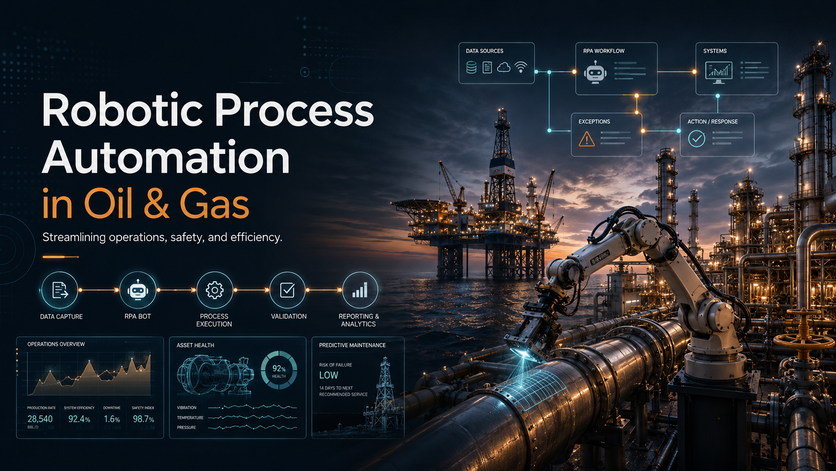
By 2026, the oil and gas industry is going to be revolutionised by RPA with how companies manage compliance, production reporting & asset maintenance processes. People on the ground in the oil industry are using automation to collect production data from multiple places, get regulatory reports done faster, keep an eye on equipment maintenance schedules & automate approval processes across all the teams in the business. This has the result of reducing a lot of manual data handling, making reports more accurate and giving decision makers a faster way of getting to know how the operation is running. We’ve seen other projects using automation reduce manual reporting workloads by over 95% and get reports done in minutes instead of days – thanks to automated data flows and automated reporting.
One of the biggest advantages of RPA in the oil and gas industry is that it works on top of the systems that most companies have been using for years. Many of these old systems in ERPs, SCADA, spreadsheets & maintenance platforms can be difficult or expensive to replace, which is where RPA comes in – it lets companies automate workflows across all these systems without having to replace them. This makes automation a lot faster to set up, less likely to disrupt operations, and much less of a risk than a full-on replacement of the whole technology stack.
Here at Vidi Corp, we’ve got RPA consulting experience of working with big multinational operators (like Schlumberger), oilfield inspectors and acquisition advisors to automate reporting, data consolidation, maintenance tracking and lots of other operational workflows. This includes building automated reporting pipelines, linking up legacy systems with APIs and RPA, and creating real-time operational dashboards that help people keep track of what’s happening in complex industrial environments.
In this article, we’re going to be looking at the office and operational workflows that RPA can automate in oil and gas organisations. That includes things like finance, compliance, procurement, production reporting, maintenance coordination and inspection management. These automations are already in use on the ground in the field and are helping energy companies create more connected and efficient operational environments
RPA works by using software to trick the system into thinking someone is doing things manually. In oil and gas companies, these bots can log into ERPs, production reporting systems, engineering tools, regulatory portals and move data, generate reports, update records and start workflows off automatically. Because RPA interacts with the system through the user interface, it usually doesn’t need a deep code-level integration. As workflow automation consulting specialists, we connect these legacy systems and automate the reporting and approvals that sit on top of them.
In the oil and gas industry, most companies combine RPA tools like UiPath, Power Automate or Automation Anywhere with OCR and AI tools. OCR takes data out of inspection reports, invoices and PDFs while AI does predictive maintenance and anomaly detection. RPA can also link in with SCADA systems, historian databases and reporting platforms to automate operational reporting and maintenance workflows.
Unlike traditional scripting, enterprise RPA platforms have built-in governance, audit trails, exception handling, permissions and workflow monitoring – which makes them perfect for big oil and gas companies running hundreds of automated processes across lots of different departments.
One of the biggest advantages of RPA is that it works on systems that are still common in the industry, even though they were introduced 20 years ago. Many operators are still using software from the 90s and 2000s, instead of replacing these systems, RPA automates workflows around them, reducing disruption, risk and big capital expenditure.
Driving Efficiency: RPA automates repetitive tasks like production allocation, invoice matching, shipment scheduling and maintenance data reporting. This reduces delays caused by manual data entry and accelerates workflows across the business.
Reducing Costs: Oil and gas operators handle a huge number of operational tickets, inspection records, procurement requests and compliance workflows every day. RPA reduces the manual effort required to process these transactions, which can lower operational costs by 20-50%, depending on the complexity and level of automation.
Improving Quality and Consistency: Manual reporting in the energy sector often involves complex calculations, unit conversions and royalty or tax reporting rules. RPA bots follow predefined logic consistently, reducing the risk of reporting inaccuracies and calculation errors. This improves trust in operational and financial data and saves time spent validating reports.
Strengthening Regs and ESG Compliance: RPA improves traceability by automatically recording process steps, approvals and data changes. This is especially valuable for environmental reporting, emissions disclosure, safety incident management and regulatory submissions. Automated workflows also help standardise documentation and ensure reporting deadlines are consistently met.
Enhancing Workforce Productivity: RPA lets engineers, planners, finance teams and analysts spend less time on copy-pasting tasks and more time on analysis, forecasting and decision making. This improves job satisfaction and helps companies retain skilled employees by reducing administrative workload.
Supporting Legacy Operations: Many oil and gas companies are still using old systems from decades ago. RPA enables automation on top of these systems without major platform replacement projects – helping companies modernise workflows while avoiding costly infrastructure disruption.
Oil & Gas Automation Solutions: Oil and Gas Companies are starting to apply RPA across a range of areas – finance, operations, maintenance, compliance, and supply chain workflows. This move is to cut down on all the manual work and get a better view of what’s going on. These automation solutions often bring together RPA, AI, OCR and analytics platforms to simplify processes, all without having to replace those legacy systems that are so deeply ingrained across the industry.
In the following sections, we’re going to share some real-world examples of automation solutions that our RPA consultants have built for clients – these examples show how Oil and Gas companies can automate business intelligence reporting, maintenance coordination, compliance workflows and operational processes to really improve efficiency, accuracy and decision making.
Oil and gas companies are applying RPA across finance, operations, maintenance, compliance, and supply chain workflows to reduce manual work and improve operational visibility. These automation solutions often combine RPA, AI, OCR, and analytics platforms to streamline processes without replacing the legacy systems already used across the industry.
In the following sections, we’ll discuss real automation solutions that we delivered to clients as part of our RPA managed services. These examples demonstrate how oil and gas companies can automate reporting, maintenance coordination, compliance workflows, and operational processes to improve efficiency, accuracy, and decision-making.
Incident management automation helps Oil and Gas companies to standardise how safety incidents, near misses and compliance observations are reported and escalated. HSE teams, field inspectors, supervisors and offshore personnel all use these systems to submit incidents directly from their mobiles, which speeds up reporting time and gets better visibility right across sites and facilities.
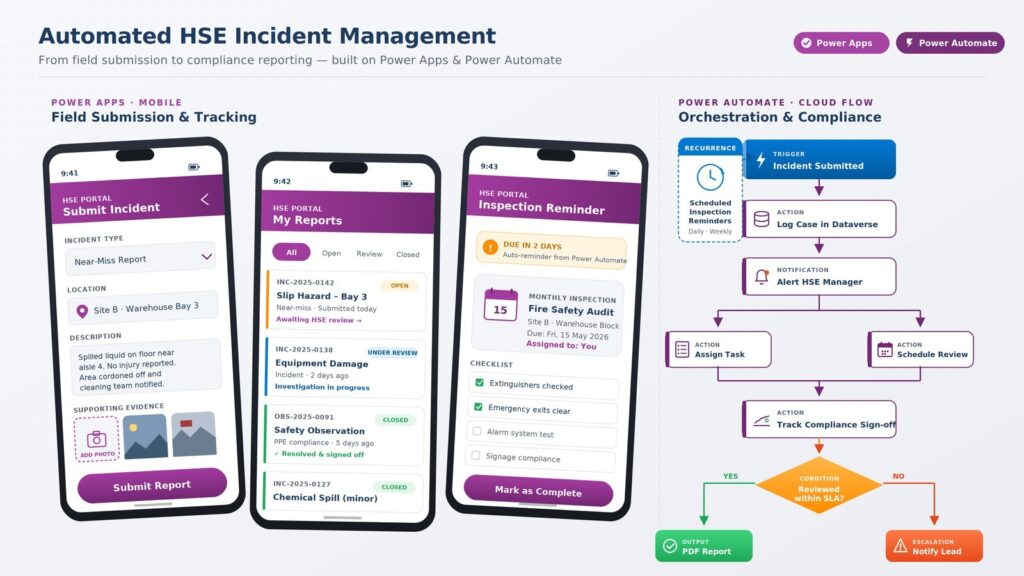
We built a Power Apps solution with Power Automate for a client to automate their HSE incident management workflow. Workers could submit incidents, near miss reports, safety observations and supporting evidence such as photos – all through a Power App. Power Automate then logged the case, alerted the HSE manager, assigned investigation tasks, scheduled review meetings, tracked compliance sign-offs and even generated pdf compliance reports – all done automatically. The workflow even automated safety inspection reminders and escalation processes to make sure incidents got reviewed within the required timeframes.
This meant the client had better compliance tracking and reduced delays caused by manual processes. Before, incident forms were emailed between departments, approvals were often missed, and escalation workflows lacked visibility. By automating the whole process, the client created a single audit trail for incidents, cut response times and ensured safety documentation was consistently captured and stored for regulatory reporting.
Invoice processing and procurement robotic process automation helps Oil and Gas companies manage high volumes of supplier transactions in a more efficient way. Procurement teams, finance departments and operations managers all use these workflows to process purchase orders, onboard vendors, approve invoices, and track contract renewals right across multiple sites and suppliers.
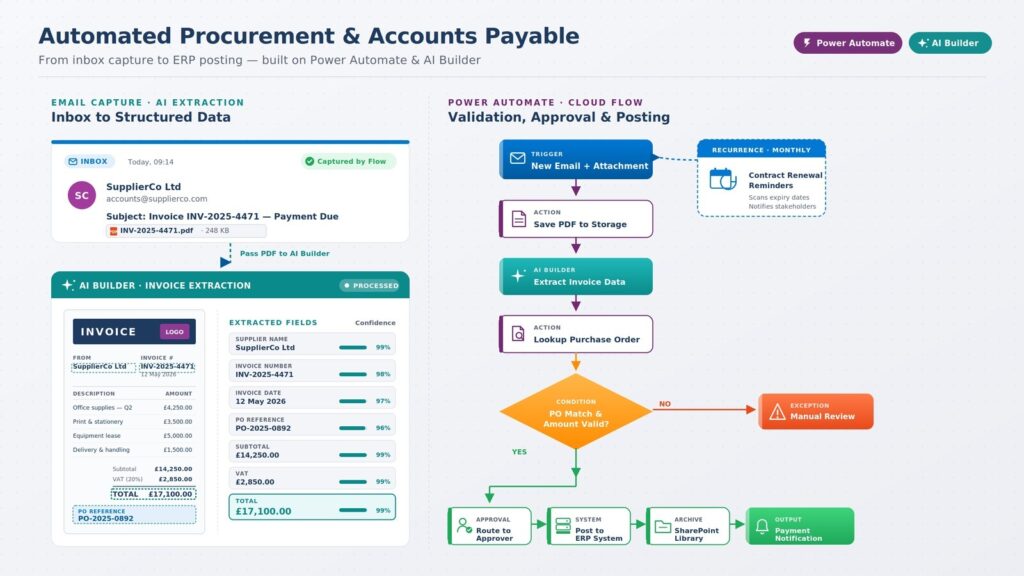
We developed a Power Automate flow to automate procurement and accounts payable workflows for a client. Invoice pdfs arriving via email were automatically captured using Power Automate, while AI builder extracted invoice data such as supplier name, invoice number, and amount. The workflow then validated the invoice against the corresponding purchase order, routed approvals to the right managers, posted approved data into the ERP system, archived documents into SharePoint and even triggered payment notifications or contract renewal reminders automatically.
This automated process cut down on the delays caused by manual invoice handling and approval bottlenecks. Before, procurement teams relied on emailed documents, spreadsheet tracking, and manual data entry – which created duplicate work, missed approvals and inconsistent audit trails. By automating the whole workflow, the client improved processing speeds, reduced administrative workload, and created a more reliable procurement process with better visibility across finance and operations teams.
Production reporting automation is helping Oil and Gas companies to turn daily operational data into clear performance reports. Operations managers, finance teams and delivery leaders all use these reports to track production performance, billable utilisation, cost recovery and revenue trends right across teams, assets and time periods.
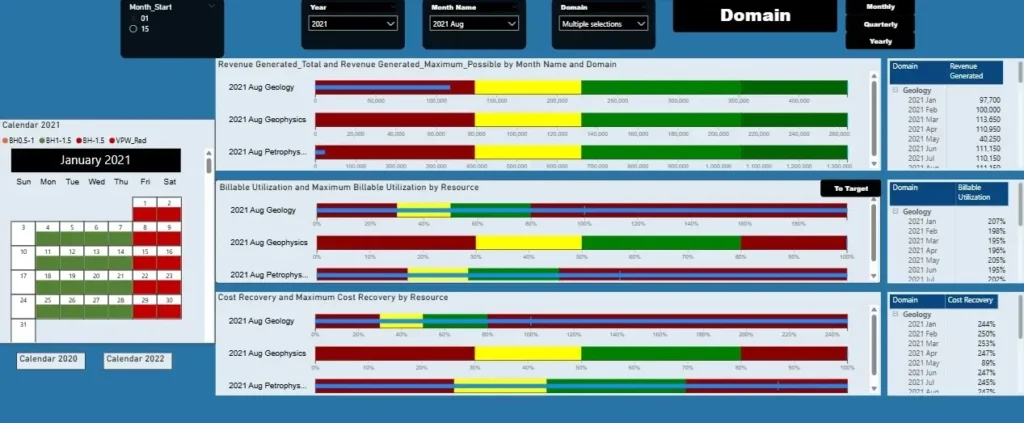
We built an oil and gas business intelligence dashboard in Power BI supported by automated data workflows in Power Automate for a client. The dashboard tracked revenue generated, billable utilisation and cost recovery on a regular basis – including monthly, quarterly and annual. It included bullet charts comparing actual performance against best-case targets, detailed monthly tables for trend analysis and a calendar view showing daily utilisation against planned capacity.
This gave management a clear view of whether teams were converting planned effort into billable revenue and recovering their full cost – and highlighted any delivery risks early, so they could be addressed before it was too late.
Inventory and MRO automation is helping Oil and Gas companies to track equipment, spare parts, calibrations and maintenance readiness across multiple sites. Technicians can scan used equipment right through a Power App, while Power Automate updates inventory records, logs usage, and keeps asset data ready for reporting.
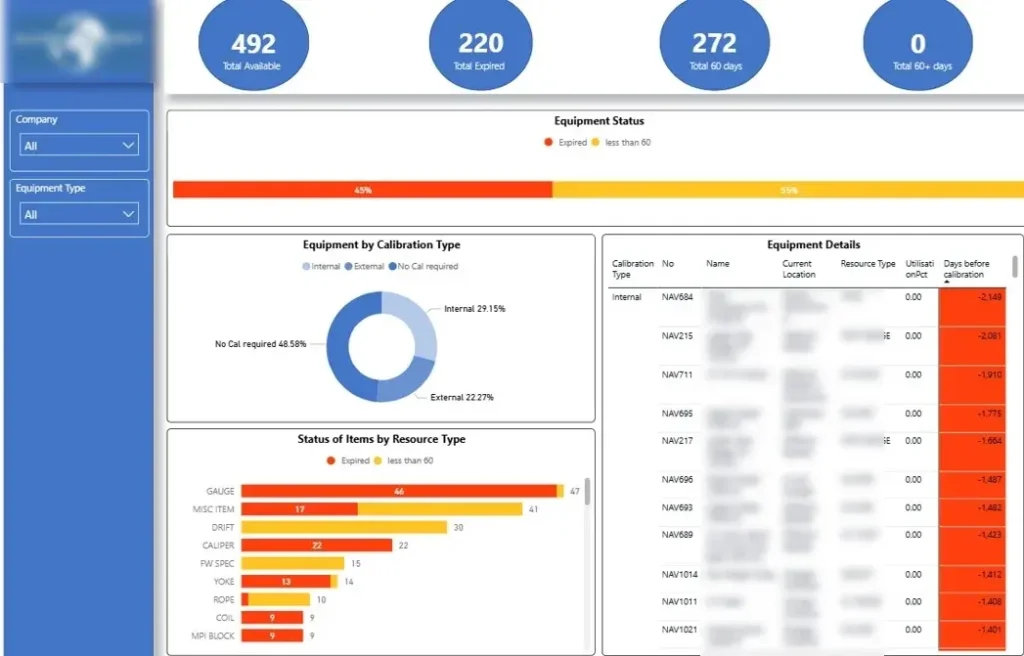
We built this type of solution for an oilfield inspection services company supporting operators like Schlumberger. The client managed over 500 pieces of equipment across three countries, including assets worth up to £80,000. Power Automate helped update inventory records, and we then created a Power BI dashboard showing expired calibrations, upcoming maintenance, equipment type, and whether calibration could be completed internally or outsourced.
This oil and gas analytics solution gave the client a single view of equipment status across all entities – and allowed them to prioritise expired or high-risk assets, plan maintenance before jobs were affected, and avoid deploying non-compliant equipment. This reduced the risk of failed inspections, costly rework, and damaged client trust.
A Field Inspection App lets oil and gas teams get that vital inspection data straight from the ground – or at least from the site, asset or field location. Inspectors, techs and supervisors can just whip out their phone or tablet, open the app, select the asset they’re inspecting, run through a checklist, take some snaps, jot down some notes and then submit the inspection all from the field.
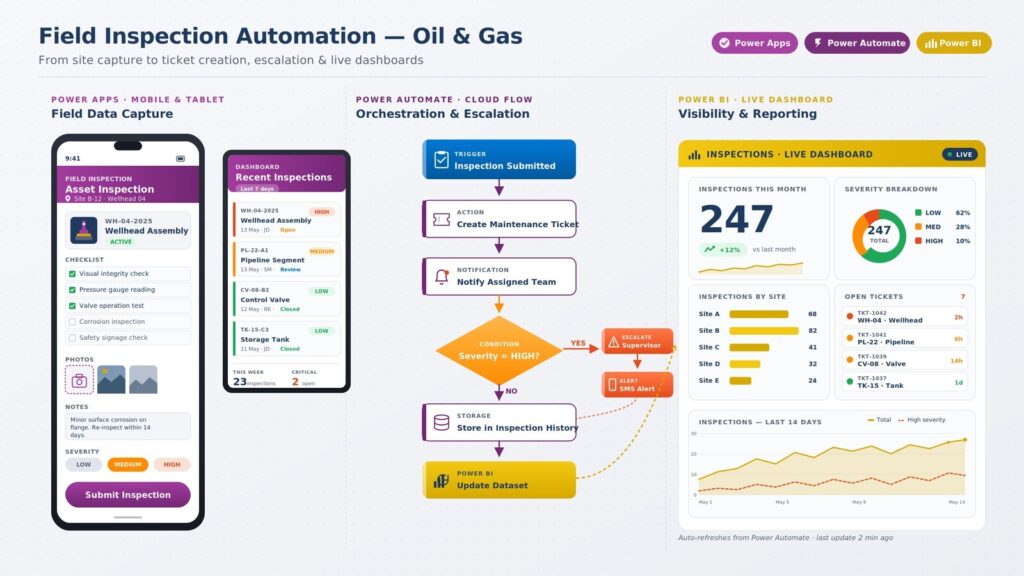
We built a solution like that using Power Apps and Power Automate for clients who were sick of muddling along with a slow and unstructured inspection process. Once that inspection is submitted, Power Automate kicks in to create maintenance tickets, send alerts to the right teams, escalate any problems that need urgent attention, store inspection history and sort out Power BI dashboards in the background.
That means ops teams get a solid view of equipment condition and what’s coming out of inspections. They also avoid missing follow-ups, are better at collecting evidence and can get their managers to act on serious issues before they become a problem for safety, compliance or service delivery.
These days, oil and gas companies are starting to move on from the old rule-based RPA bots and get into the smart automation powered by AI and machine learning game. By using Power Automate, AI Builder and ChatGPT integrations, they can now automate workflows that involve unstructured documents, operational analysis and decision making rather than just the same old repetitive data entry tasks. This means those automation systems can actually understand documents, classify issues, set priorities, and help operational teams make smarter decisions.
Within Power Automate, AI Builder can use OCR & natural language processing to pull out the useful data from engineering drawings, inspection logs, invoices, calibration certificates and PDF reports. Field teams and engineers don’t have to spend their day reviewing documents – they can upload files into a Power App or SharePoint folder, and Power Automate gets on with reading the content, extracting the good stuff, checking it, and routing it off to the downstream workflows or reporting systems.
Machine learning models can also keep an eye on operational data and classify unusual stuff like abnormal pressure readings, compressor problems or unusual maintenance patterns. Once something looks like a potential issue, Power Automate can trigger the workflows that open up maintenance work orders, send alerts to the engineering teams, escalate critical risks, or schedule inspections. ChatGPT integrations can also help out by summarizing inspection notes, categorizing incidents or generating draft maintenance
Oil & Gas companies operate in a super-tight regulatory environment in regions like North America, the North Sea and the Middle East. The result is that automation projects have to have very robust compliance controls, audit trails and operational security in place.
RPA can definitely help with compliance by enforcing standard workflows, getting the right approvals in place and keeping complete audit logs for every automated action. That’s particularly useful for things like environmental reporting, HSE processes, contractor management and financial controls, where any gap in the documentation or inconsistency in the reporting can mean serious regulatory risk.
Security is also a major concern because automation workflows are accessing sensitive systems, employee data and production information. Companies manage this by using role-based bot permissions, secure credential vaults, segregating duties and keeping a close eye on everything with corporate IT policies.
But to keep operational risk to a minimum, you should also make sure that your automated workflows have some basic safety net – i.e. exception handling, escalation rules and fallback paths to human review – so that critical business processes can continue to run smoothly even if systems, integrations or automation services fail.
The first step in RPA implementation is to figure out which high-volume, rules-based processes are worth automating across finance, operations, procurement, maintenance and HSE. It’s usually the processes that involve loads of repetitive manual work, crystal-clear business rules and a clear return on investment that get priority. So, you’re looking for things like invoice processing, production reporting, inspection management and contractor onboarding.
Once you’ve picked your target processes, the next step is to design the automation workflows and build a test environment before deploying. That usually involves mapping out how approvals will work, defining how you’re going to handle exceptions and using tools like process mining and simulation to make sure that workflows will behave as planned under real-world conditions.
Oil & Gas operators usually start with controlled pilots focused on a single refinery, pipeline system, production team or business unit. Success is measured by things like cycle time reduction, error reduction, reporting speed and manual time saved – before you start making decisions about rolling it out more widely.
Once the pilots have been successful, then you can start expanding automation into more areas of the business and more processes. At this stage, RPA is often being integrated with AI Builder, machine learning models, analytics platforms and digital twin environments to support things like predictive maintenance, intelligent document processing and operational forecasting.
Mature automation programs are continuously monitoring bot performance, capturing new automation ideas from operational teams and adapting workflows as the business or regulations change. Companies that establish a long-term governance framework are usually able to scale automation more effectively across multiple business units and regions.
Oil & Gas companies often come up against several operational and organisational challenges when implementing RPA. Addressing these early on is key to long-term automation success.
Change Management: Employees may see automation as a threat to their jobs – especially in admin or operational support functions. Successful projects usually concentrate on reducing repetitive work, improving safety and allowing engineers and planners to focus on more important decision-making and operational tasks.
Legacy systems and technical debt: Many operators still rely on old refinery, pipeline and ERP systems that lack modern APIs or integration capabilities. RPA helps by automating workflows through the existing UI without needing a full system replacement.
Process variability: Processes can differ significantly between regions, assets and business units, making it harder to scale automation. Standardising workflows and getting clear business rules in place before automation makes all the difference.
Scalability and governance: As automation programmes grow, you need a centralised governance framework, development standards and security controls. Quite a few operators set up an automation CoE to manage priorities, compliance, bot monitoring and technical standards across the business.
Measurement and ROI: Tracking automation impact from the start is essential. Common metrics include hours saved per month, reduction in manual errors, faster reporting cycles, improved compliance tracking and operational incidents avoided. Transparent reporting helps demonstrate business value and secure support for further automation investment.
Between 2026 and 2030, intelligent automation will continue to expand across Oil & Gas operations as RPA, AI and analytics platforms become more interconnected. Automation will increasingly support operational decision-making, predictive maintenance, compliance reporting and asset management rather than just the repetitive admin tasks.
Low-code platforms like Power Apps and Power Automate are already making it possible for engineers and planners to build their own automations with minimal development effort. Meanwhile, machine learning models will drive more predictive maintenance workflows by automatically triggering maintenance scheduling, procurement and reporting actions through integrated automation systems.
Intelligent automation will also become increasingly important for carbon accounting, emissions reporting, renewable integration and broader ESG initiatives. Companies that treat automation as a long-term operational capability rather than isolated projects will be better placed to manage regulatory change, operational complexity and market volatility.
Robotic Process Automation is quickly becoming a go-to operational strategy for oil and gas companies looking to boost efficiency, tighten up their compliance game and simply get their workforce off the manual workload treadmill without having to rip out their existing systems. From checking out the state of the fields and getting contractors up and running to crunching production numbers and – as a bonus – predicting when things might need fixing, we’re seeing companies use intelligent automation to speed up and make their workflows way more reliable and scalable throughout the entire business.
As the tools we use – like AI, machine learning and low-code platforms – keep getting better, you can bet the role of intelligent automation in oil and gas is going to keep growing. Companies that get on the automation wagon soon, especially with a strategy that can scale, will be better equipped to handle the operational headaches, regulatory heat and market whiplash that are just around the corner.
If your oil and gas company is thinking of bringing in RPA, Power Apps or Power Automate solutions – and you’d like to get a better handle on the potential for automating your processes – give our consultants a call – we can have a chat about what you’re trying to do and where the opportunities are.


