

RPA implementation is the process of deploying software bots to handle repetitive, rule-based tasks — freeing your team to focus on work that requires judgment. Done well, it cuts processing time, reduces errors, and lets you scale operations without adding headcount. However, according to Forbes, 30-50% of initial RPA projects are unsuccessful mainly due to insufficient planning
As seasoned Robotic Process Automation consultants, we’ve helped businesses like Ray Ban, Delta Airlines and American Express to identify the right processes to automate and build bots that continue delivering value long after go-live. For example, one client reduced 80 hours of manual data entry per week — simply by automating the production of audit report templates.
This article walks through the 7 steps to a successful RPA implementation: from defining your business outcomes and building a financial case, to running a proof of concept, contracting with the right partner, and scaling your automation program over time.
Robotic Process Automation (RPA) uses software bots to handle repetitive, rule-based tasks — the kind that consume time without requiring judgment. This frees your team to focus on work that actually moves the business forward.
RPA sits at the core of intelligent automation, combining with AI and machine learning to handle entire processes, not just isolated steps. This allows organisations to process both structured and unstructured data with little human input.
A successful implementation starts with knowing your processes well. The best candidates are high-volume, rule-based, and prone to human error. Choosing the right processes from the start is what determines whether your RPA programme delivers lasting value.
RPA implementation follows a structured approach to deploying and embedding automation across an organisation. It is widely used in banking, insurance, retail, and healthcare to automate manual, rule-based tasks — improving efficiency, accuracy, and compliance in the process.
A successful RPA programme is built across five layers:
1. Process Intelligence & Selection Mine system logs, interview stakeholders, and use process-mining tools to identify the strongest candidates. Rank opportunities by volume, rule-based logic, and potential value.
2. Business Case Engineering Translate cycle time, error rates, and labour effort into concrete savings and risk reduction figures. This is what secures executive sponsorship and keeps the programme funded.
3. Technical Architecture & Build Map the target state and select the right platform — UiPath, Automation Anywhere, Power Automate, or Blue Prism. Build automations with solid exception handling, credential vaulting, and logging from the start.
4. Operationalisation & CoE Setup Define intake rules, development standards, and bot lifecycle management. Without these, automations break when systems upgrade or teams change.
5. Scale, Measure, Optimise Track bot utilisation, SLA adherence, and failure patterns through dedicated dashboards. Use that data to guide continuous improvement across the programme.
Integrating RPA with AI and other advanced technologies takes this further — enabling the automation of entire processes, not just individual tasks.
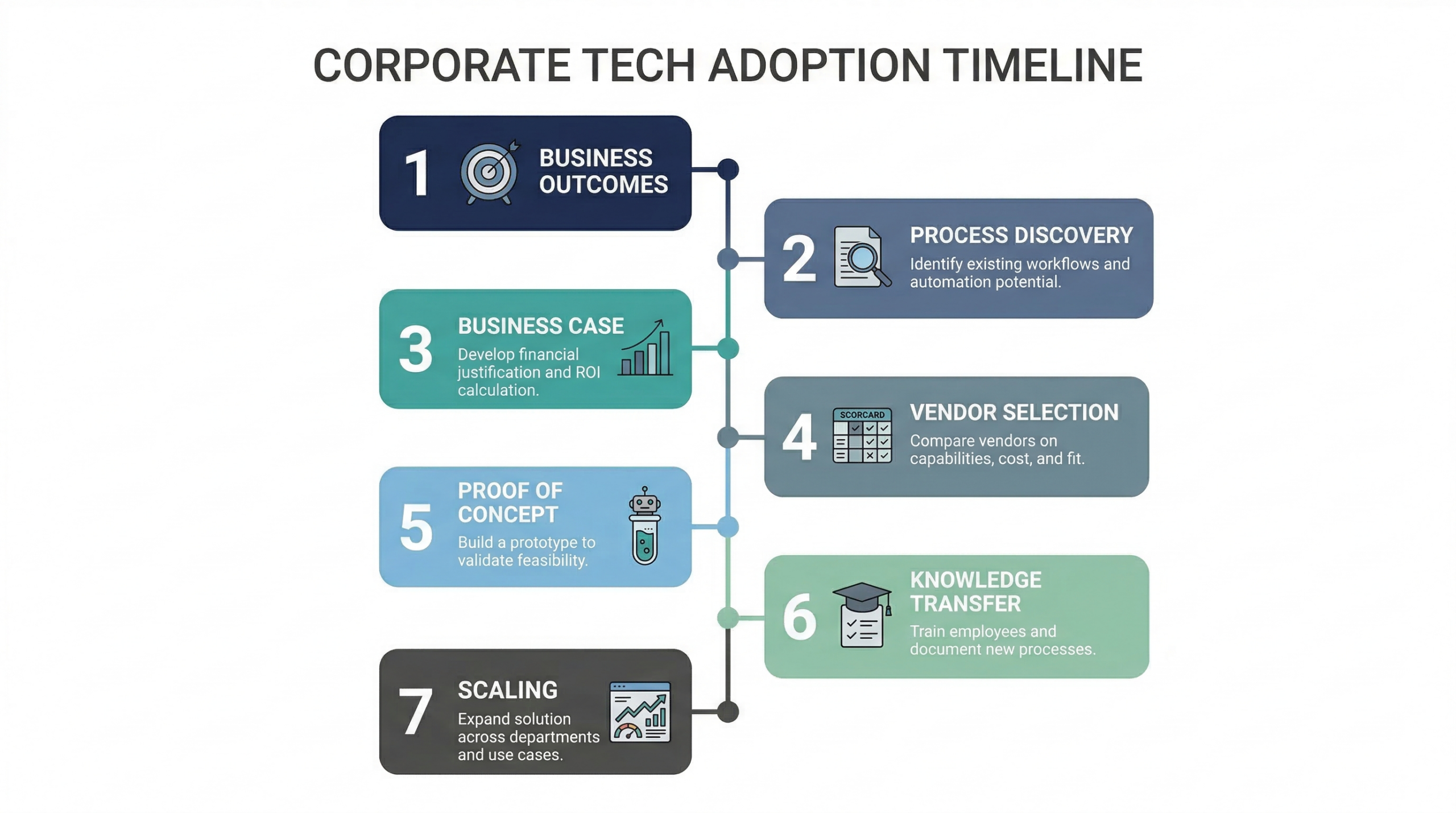
Start with business language, not tools. Before selecting any platform or process, define what you need to achieve — for example:
Choose a process that is stable and unlikely to be discontinued. The longer the process stays in place, the longer you benefit from the automation.
Be as specific as possible. Vague goals produce vague results. Name the exact process you want to improve and define what success looks like for that process specifically.
Deliverables: Problem statement deck, current-state metrics spreadsheet, success KPIs, stakeholder map, preliminary value hypothesis.
At this stage, you are analysing the process in detail to confirm it is a strong candidate for automation. The best candidates are repetitive and require little subjective judgment — data entry, data extraction, data transformation, and template population are typical examples.
Break the process down into specific tasks and document each one. RPA consultants will have questions throughout development, and clear documentation speeds up the entire build. Undocumented processes lead to delays and rework.
Many processes involve input from multiple departments at different stages. If that applies here, record which team is responsible for each step. The clearer the picture of the process, tasks, and ownership, the stronger the case for automation.
Deliverables: Opportunity backlog ranked by value/complexity, heat map, quick-win shortlist, and initial automation wave plan.
Once you’ve confirmed a process can be automated, the next step is proving it should be. That means mapping out the full costs and benefits before any development begins.
Common benefits to quantify:
Costs to account for:
Deliverables: 3-year P&L impact, NPV/IRR model, sensitivity analysis, capital vs. opex funding plan.
Build a weighted scorecard across technical fit, domain expertise, governance maturity, tool ecosystem certifications, commercial model, and their Business Process Automation examples. This gives you an objective basis for comparison rather than relying on sales presentations alone.
Start with reviews. Your business process automation partner should have verified reviews from projects similar to yours in scope, industry, and complexity. Volume matters, but relevance matters more — a strong track record in your type of process is a better signal than a long client list.
Beyond reviews, assess whether the consultant genuinely understands your process. Gaps in understanding at this stage lead to revisions, delays, and higher costs during development. Make sure they can articulate your scope back to you before any work begins.
For larger programmes, also consider scalability and governance depth. Enterprise-grade automation requires a partner who can support deployment across multiple processes and teams — not just deliver a single bot.
Deliverables: Scorecard workbook, demo scripts, executive recommendation memo.
Choose one representative process to automate first — not the simplest task you can find, but not a high-risk regulatory process either. Time-box the PoC to 4–8 weeks and define success metrics upfront: automation coverage, cycle-time reduction, exception rate, and evidence that the bot can be maintained without heavy rework.
Include user acceptance testing and handover documentation as part of the PoC. Without these, you risk building demo-ware — something that works in a controlled environment but never scales into production.
Before moving to full deployment, confirm the solution is scalable and aligned with your broader business objectives. Use the lessons learned from the PoC to refine your design standards before rolling out across additional processes.
Deliverables: Deployed pilot bot, comparison metrics vs. baseline, technical debt log, go/no-go decision deck.
Building a working bot is only half the job. If the people who will use and maintain it don’t understand how it works, adoption stalls and the bot becomes a liability rather than an asset.
Start with a structured handover. Walk the internal team through the bot’s logic, exception handling, and failure points. Provide written runbooks that cover how to monitor it, what to do when it fails, and who is responsible for each part of the process.
Run targeted training sessions for anyone whose workflow the bot touches — not just the technical team. Business users need to understand what the bot handles, where it hands back to a human, and how to flag issues. The more familiar they are with the automation, the faster they’ll trust it.
Track adoption alongside performance. Monitor whether the bot is being used as intended, whether users are bypassing it, and whether exception volumes are higher than expected. Early signals of low adoption are easier to address than entrenched workarounds.
Deliverables: Runbook documentation, admin training sign-off, user training completion log, adoption metrics baseline.
Once your automation is live, tracking it is not optional. Build error alerts from the start so failures are caught early and resolved before they affect the business. Most issues can be fixed quickly once you know where to look.
Set up analytics reports to monitor error rates, categorise failure types, and track how performance changes month on month. This gives you the visibility to improve existing bots and make informed decisions about what to automate next.
As the programme matures, scaling means more than deploying additional bots. Integrating AI and analytics, expanding across departments, and managing your digital workforce through a centralised platform all become priorities. A well-run Centre of Excellence (CoE) is what keeps this growth structured and sustainable.
Deliverables: CoE charter, operating model (centralised/federated/hybrid), governance playbook, pipeline management tooling, quarterly value reports.
Before implementing RPA, it’s crucial to ensure your business processes are optimized for automation. Jumping straight into automation without first refining workflows can lead to automating inefficiencies, which undermines the benefits of RPA.
Start by analyzing your existing business processes to identify bottlenecks, redundancies, and unnecessary steps. This process optimization phase allows you to streamline workflows, improve process efficiency, and eliminate tasks that don’t add value. By doing so, you not only make your processes more effective but also set a solid foundation for implementing RPA.
RPA tools can assist in this optimization journey by providing data-driven insights and recommendations for improvement. These platforms can help map out current workflows, highlight areas for enhancement, and prioritize tasks that are ideal candidates for automation.
Optimizing processes before automation also helps organizations develop a clear implementation plan. It enables you to identify high-impact automation opportunities, allocate resources effectively, and reduce the time and effort required for RPA deployment. Ultimately, process optimization ensures that your RPA initiatives deliver sustainable results and maximize return on investment.
Thorough testing and quality assurance are vital to the success of any RPA project. Automated processes must be reliable, accurate, and seamlessly integrated with existing systems to deliver consistent business value.
RPA testing involves validating that software robots perform tasks as intended, handle exceptions gracefully, and interact correctly with enterprise systems and applications. This includes verifying data accuracy, ensuring compliance with business rules, and confirming that the automation tool can adapt to changes in underlying systems.
Quality assurance doesn’t end with initial deployment. Continuous monitoring, feedback loops, and analytics are essential to detect issues early, measure performance, and drive ongoing improvements. Many leading RPA tools offer built-in features for automated testing, debugging, and real-time analytics, making it easier to maintain high standards of process automation.
By prioritizing testing and quality assurance, organizations can minimize errors, reduce operational risks, and ensure that their RPA solutions consistently meet business requirements. This commitment to quality is key to building trust in software robotics and achieving sustainable automation success.
A successful RPA journey depends not only on technology but also on people. Preparing your team for RPA implementation is essential to ensure smooth adoption and long-term success of your automation initiatives.
Begin by educating employees about the benefits and limitations of RPA. Clear communication helps dispel myths, address concerns about job security, and build trust in the automation process. Providing targeted training on RPA tools and software empowers business users, RPA developers, and analysts to collaborate effectively in designing and testing automated processes.
Involve key stakeholders early in the process to identify automation opportunities and define requirements. Encourage cross-functional collaboration between business units, IT, and RPA developers to ensure that automated processes align with business needs and deliver measurable value.
Change management plays a critical role in RPA initiatives. By fostering a culture of innovation and continuous improvement, organizations can minimize disruption, encourage adoption, and ensure that RPA bots are embraced as valuable digital workers rather than seen as threats.
By investing in team preparation, you lay the groundwork for successful RPA implementation, enabling your organization to fully realize the benefits of automated processes and drive ongoing business transformation.
Let’s now look at how those 7 RPA implementation steps can be applied based on the case study. In this case study, we helped the UK-based engineering consultancy to implement RPA within its organisation.
Their consultants visited clients to conduct audits and surveys and collected valuable data using a program called iAuditor. The consultants then used the gathered data to populate the Word templates and present the results of the audit to the client.
We started our implementation by defining the desired business outcomes, such as:
In step 2, we analysed the process in more detail. The process involved extracting the data from iAuditor, transforming it and pasting the values into a Word template. This was a very repetitive process with a lot of values to insert into the templates.
The process was performed by the client’s consultants, who charged £40-50 per hour. The process took 80 working hours per week, leading to an equivalent cost of £3,200 – £4,000 per week.
Knowing the potential benefits, we moved to a proof of concept where we fully automated the production of 1 template. This included pasting images into the relevant placeholders and inserting calculated fields in others.
To automate these tasks, we developed Power Automate flows that instructed bots to extract data using application programming interfaces (APIs) and populate the templates efficiently. We also leveraged intelligent document processing tools to enhance data capture accuracy and streamline the automation of document workflows.
Once the client saw the full automation of a single template, we moved forward with automating 20+ others over the next several months.
Finally, our Power Automate consultants usually implement alerts to stay updated on the errors and quickly react to them. Every time an error occurred, we would receive an automated email and start our troubleshooting.
RPA transforms business operations by automating complex processes with precision. It drives efficiency, sustains 24/7 productivity, and fast-tracks critical decisions, allowing teams to redirect their expertise toward innovation and growth-oriented challenges. Our RPA leverages software to automate repetitive, rule-based tasks, enabling businesses to streamline operations, reduce costs, and empower employees.
RPA operates 24/7 without breaks, dramatically accelerating task completion. By leveraging task automation, businesses can streamline operations by automating repetitive, rule-based office tasks, leading to faster and more consistent results. Processes like invoice processing, data entry, or report generation that once took hours or days are now completed in minutes.
Labour-intensive tasks account for a substantial portion of operational costs. RPA slashes expenses by automating up to 70% of repetitive work, reducing reliance on large teams.
Humans are prone to fatigue-induced mistakes, especially in monotonous tasks. RPA ensures near-perfect accuracy by following predefined rules
RPA allows businesses to scale operations effortlessly. During peak seasons, retailers deploy additional bots to handle order processing without hiring temporary staff. Bots adapt quickly to fluctuating workloads, ensuring agility in dynamic markets.
Faster, error-free processes translate to superior customer service. Bots handle inquiries instantly, such as resetting passwords or tracking orders. RPA implementation can also automate customer research and inquiry processing, enabling banks to quickly gather relevant information and respond to customer needs more efficiently.
Use (or adapt) the scoring grid below during RFP finals presentations. Weight categories to reflect your risk appetite.
Create a 1–5 scoring scale under each bullet; attach comments and red flags.
Robotic process automation pricing varies by geography, scope, and platform, but market data offers directional anchors.
Fixed‑Price Pilot / PoC – Good for contained use case; reduces initial risk; expect change‑order triggers.
Time & Materials (T&M) – Flexible; best when scope unclear; monitor burn closely.
Managed Automation Service / Bot‑as‑a‑Service – Vendor hosts and runs bots; pay subscription per bot or transaction; shifts spend to opex; helpful for lean IT teams.
Outcome‑ or Gain‑Share‑Linked – Less common but growing; consultant fees tied to documented savings or throughput targets.
| Cost Component | Cost Range / Benchmark | Notes & Typical Inclusions |
| Fixed‑Price Proof of Concept (PoC) | US $1,000 – US $10,000 | Mid‑market projects; exact price depends on scope, complexity, and success criteria. |
| Consulting Labour (Architect / Lead Developer) | US $75– US $120 per hour | Global blended rate; expect higher bands from tier‑1 firms or in premium markets. |
| Cloud RPA Licensing – Starter Bundle | US$150 a month | Example (Automation Anywhere): 1 unattended bot, 1 creator seat, 1 control room. Prices vary by vendor. |
| Incremental Attended Bot Seat | US$15 per user / month | Adds capacity for human‑in‑the‑loop automations. |
| Additional Unattended Bot Capacity | US$150 per bot / month | Scales fully autonomous bot workloads. Platform‑specific; request tailored quotes. |
The depth of the delivery team often determines success more than the brand on the slide.
Ask prospective consultants to provide counts of active certifications by individual, not just corporate partner badges.
Most failed RPA programs do not die of technology; they die of governance neglect. Without intake rules, coding standards, change management, and monitoring, bots break when UIs shift, credentials expire, or upstream data formats drift.
Established operating models all emphasise starting governance early, before proliferation. Mid‑market firms can simplify, but should not skip core controls.
If any of the above sound familiar, elevate governance to a board‑visible risk item and scope remediation into your consulting engagement.
While RPA offers significant benefits, organizations often encounter challenges during implementation that can hinder RPA adoption and success. Common obstacles include resistance to change from employees, lack of effective governance, inadequate IT infrastructure, and insufficient training for business users and RPA developers.
Poorly designed business processes, inadequate testing, and lack of ongoing monitoring can also undermine RPA initiatives, leading to unreliable automated processes and missed business goals. Without a clear implementation plan and strong leadership, RPA projects may stall or fail to deliver expected results.
To overcome these challenges, organizations should invest in comprehensive change management, establish robust governance frameworks, and provide continuous support and training. Engaging with experienced RPA vendors and providers can also help navigate technical complexities and ensure best practices are followed throughout the automation journey.
By proactively addressing these common challenges, businesses can achieve successful RPA implementation, maximize the benefits of automation, and drive meaningful digital transformation across their operations.
Robotic Process Automation isn’t a one‑and‑done software install; it’s a strategic, iterative journey that starts with clear objectives, moves through careful process selection, and matures only when governance, change management, and continuous optimisation become second nature. By following the step‑by‑step roadmap we’ve outlined, you set the stage for bots that deliver durable ROI rather than short‑lived wins.
Keep people at the heart of the rollout, celebrate quick successes to build momentum, and revisit your automation pipeline regularly to capture new opportunities as the business evolves. Do that, and RPA becomes more than a productivity tool; it transforms into a catalyst for innovation, freeing your teams to focus on the creative, customer‑centric work that fuels long‑term growth.


