

Data analytics managed services let you pass the heavy lifting of data work to a dedicated team that handles it from start to finish. You get all the reporting, dashboards and insights you need, without having to set up an in-house data function. It’s a straightforward way to turn random data into something you can actually act on.
Our team of data analytics consultants has experience delivering managed analytics to 700+ businesses in finance, manufacturing, retail, healthcare and marketing. When clients engage us on managed analytics model, we become an extension of their own analytics team and bring several specialized developers focused on data engineering, data visualization and data warehouse management.
This guide is here to break down what data analytics managed services are all about, and when they’ll make sense for your business. It covers the benefits you can expect, a real client example, and exactly how our engagement model works. Read this to figure out if a managed service could be what your business needs.
Data analytics managed services is an ongoing arrangement where you get to hand over your data analytics to an external team. This involves getting data from all your different systems, tidying it up and structuring it, before turning it into KPI dashboards and reports. And here’s the best bit: the same team is responsible for making sure it all keeps running as your data and needs change over time.
You get the benefit of a full data team without having to take on the cost of hiring one. The term is often used interchangeably with managed analytics services or managed data analytics. It gives a business an alternative to the two traditional options: either hiring a whole in-house team, or working with consultants on a one-off project.
A managed service combines both of these options into a single, ongoing relationship. Your data work gets done on a regular basis, and you don’t have to worry about the tools, pipelines, or staff – that’s the main difference between a managed service and a project.
The main reason a lot of businesses are choosing managed analytics these days is because it delivers real value over the long term – not just a one-off hit. Here’s how the two stack up:
| Category | Managed Analytics | Traditional Analytics |
| Approach | Proactive: Reports show insights in real-time to support decision-making and spot issues before they escalate. | Reactive: Reports are created after problems happen or when specifically requested. |
| Process | Continuous: Data is constantly updated, cleaned, and analysed for ongoing insights. | Reports or analyses are done on-demand with limited follow-up. |
| Expertise | Handled by a dedicated team of data professionals with broad experience. | Depends on in-house skills, which may be limited or stretched thin. |
| Setup Time | Quick to start with ready-made tools and systems. | Long setup with infrastructure, hiring, and training. |
| Cost | Predictable, fixed pricing with high ROI. | High upfront cost for tools, systems, and talent. |
| Maintenance | Fully managed and continuously optimized. | Requires constant updates and oversight by your team. |
| Quality of Insights | High-quality, consistent, and tailored to your goals. | Can be inconsistent and less actionable. |
| Scalability | Scales easily as your business grows. | Harder to scale without extra hires or tools. |
A managed service isn’t just one task – it’s a collection of connected services that all work together to get the job done. Here’s what a complete managed analytics service usually covers:
First things first, getting all your different data sources talking to each other and pulling it into one place. This means getting rid of those data siloes that keep your numbers locked away in separate tools. We set up and maintain connections to platforms like Facebook Ads, Google Ads, Google Analytics, Google Search Console, SEMrush and QuickBooks (to name just a few).
Raw data is rarely any good to use – we clean it, structure it and store it in a business intelligence data warehouse so it becomes a single source of truth. We use cloud platforms like Azure SQL and BigQuery to give you the scale and speed to grow with your business.
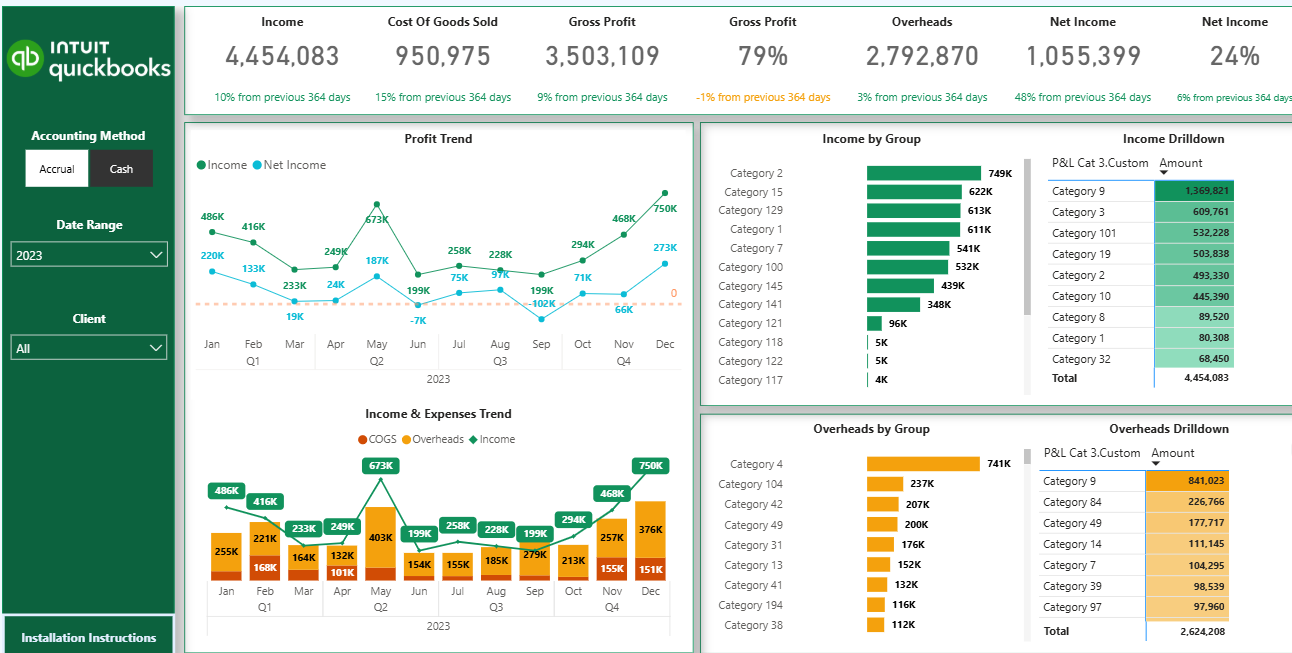
This is where data turns into decisions – we build interactive business intelligence dashboards that track your key metrics, with filters and drill-downs so anyone can find what they need. And we work in the tools you already use, like Power BI, Tableau, Looker Studio and DOMO.
The “managed” bit is all about the ongoing relationship – your management reporting gets kept up to date, new requests get handled, and the same team keeps building on what they know about your data. You don’t get left to run and sort it all out yourself after launch.
You skip the cost of hiring, training and keeping a data team on staff – you pay for the work you need, not salaries, software licences, or infrastructure. That turns a big, fixed cost into something you have more control over.
Neterra, a telecommunications company, saw this in action – the CFO reported €50,000 in cost savings straight after launch and equivalent of one full-time analyst position saved. You can read their full review on Clutch.
Manual reporting is slow and easy to get wrong – a managed service automates data consolidation so reports are ready the moment you need them. And accurate data means fewer decisions made on bad numbers.
For a home services platform, our team cut manual data consolidation by 95% – the CEO reported report generation dropping from 48 hours to under five minutes, with data integrity reaching 99.7%. You can read the details in their Clutch review.
A managed team has built these solutions loads of times before – that experience shows up in cleaner data, better dashboards, and fewer mistakes. You also avoid the cost and risk of a bad hire.
A medical device company used our team to build Power BI reports for machinery data logs and maintenance tracking – as adoption grew, the Senior Director reported a 20% increase in service revenue. Their feedback is published on Clutch.
Your team stops managing pipelines and fixing broken reports – that time goes back into the work only they can do. The data runs smoothly in the background. Isovolta, a manufacturing company, had to swap over to our team to manage their reporting and manual workflows, and as a result, we helped them save around 10 hours a month and see a significant drop in manual errors. The whole story is up on Clutch.
Data needs go up and down and a managed service adapts to fit. You add new sources, reports, and even whole business units and you don’t have to rebuild anything from scratch. Growth is no longer a reason to go out and hire more people.
Modern Cannabis is a prime example of this. We built an integrated reporting system for them and they found out that the system scaled up perfectly to add new entities with no extra setup time required, a 75% reduction in report compilation time and their month-end close was cut down by several days. They’ve shared a review on Clutch.
We’ve been working with a digital marketing agency as their outsourced analytics team and they have more than 80 clients to manage. They couldn’t personally staff the reporting so their leadership wanted to get accurate, automated reporting for every client without having to build a data department of their own.
Our team handles data extraction from sources like Facebook Ads, Google Ads, Google Analytics, Google Search Console, SEMrush and Formidable Forms. We build the reporting in Looker Studio and set up Google Analytics so their tracking is accurate from the start. We’re embedded in their Monday.com system where we pick up tasks, update status’, leave comments and chat with their team directly.
We meet up every week to review progress, plan new client onboarding and agree on what to build next. Their Director of Business Services has reported a 40% increase in reporting accuracy, around 50 hours saved each week and more than 20 hours of manual quarterly reporting taken away. We’ve had a great relationship with them for close to three years now, and the whole story is on Clutch.
Our model is all about being flexible. We get you an ongoing team without a rigid contract or a long lock-in period.
We work on an hourly basis at $75 per hour and you only pay for the hours we work. We send you a single invoice every month. There’s no minimum term to sign up for.
If you know you’ll need a set number of hours each month then you can prebook them. We reserve that capacity just for you and keep it clear of other projects. We can commit up to 40 hours a week this way.
Most projects need a lot of input during the build phase but then the work shifts to maintenance and smaller tasks. You scale the hours back as that happens, without having to renegotiate anything.
We can work inside your own systems. For one client, that meant picking up tasks directly in their Monday.com board, updating statuses and staying in daily contact. Regualr calls keep priorities clear and the work moving.
The right partner fits your goals, your tools and the way you work. For a sense of who is out there, our guide to the top data analytics companies sets out the main providers and what each is best suited to. Here are some things to look out for.
Ask for case studies and client reviews, not just some claims. A track record across different industries shows that the team can adapt to your data and any named results are a good sign that the work holds up. You won’t have to upend your workflow to work with a partner. Look for a team that already has experience in Power BI, Tableau, Looker Studio, DOMO, or Microsoft Fabric – then the transition will be seamless and handing over work easy.
Rigid service packages can leave you paying for hours that just aren’t getting used. A flexible model, whether its a straight hourly rate or you prebook a certain amount each month, lets you scale up and down as your needs change. This way you only pay for the work that’s getting done.
Your partner should be following best practices when it comes to data protection – and be happy to work within your own security protocols. Before you get started ask them about how they handle access, storage and confidentiality – the quality of their answers will tell you more than any sales pitch.
One of the main values of a managed service is that you get a real partnership, not just a team that does a job for you and then disappears. Look for a partner who is responsive, integrates with your existing processes, and stays in touch – because when things need sorting out, you need to know you can get hold of them.
Managed data analytics can give you a top-notch analytics capability without breaking the bank or taking on loads of risk. Whether you need a big push upfront or just some steady support over time, the model is flexible enough to fit your business. If you’re ready to get started, fill in the contact form below and we’ll chat about what you need.
Managed data analytics is when a team of experts run your analytical work for you. They’ll integrate your data, build models and dashboards, and keep everything running smoothly over time. Its like having your own dedicated analytics team – without the cost and hassle.
Traditional analytics is usually on demand, with reports built and then left to gather dust. Managed analytics is a continuous service – your reports are always up to date, and you have a team on hand to deal with any issues that come up.
We charge an hourly rate of $75 – invoiced once a month for the hours worked. If you know you’ll need a certain amount of work done each month, you can prebook hours and we’ll reserve that capacity for you. And don’t worry, there’s no long-term contract to sign.
A full solution covers everything from getting your data in order, to building the tools that help you make decisions. Its tailored to your needs, but the constant is a skilled team that will run and maintain it for you.
Managed analytics is a great fit for businesses with complex data setups, those who are struggling with manual spreadsheets, or those that can’t seem to keep hold of data talent. It’s also ideal for businesses where analytics is important, but its not the core of what they do.


