
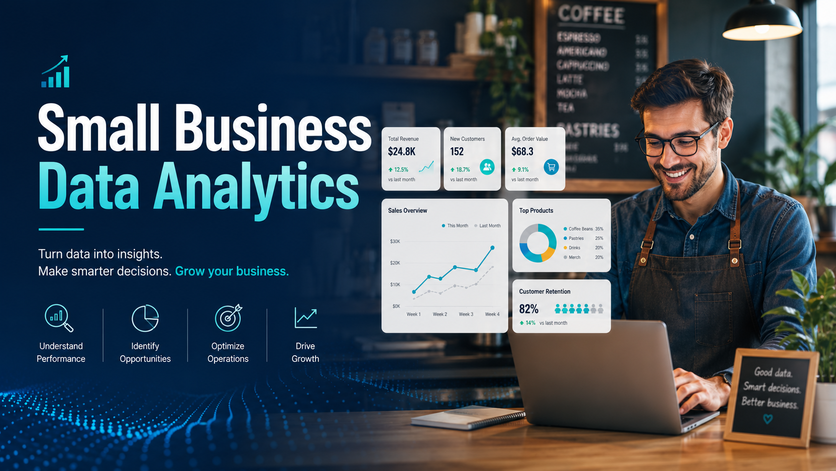
Many companies around the world are already benefiting from small business data analytics. According to Score, 51% of small business owners believe that big data is a must, but only 45% of them perform data analysis. Deloitte revealed 63% of small businesses using analytics tools report higher profitability within 6 months, highlighting 15% and more increase in sales.
Additionally, investing in automated data analytics helps small businesses owners to provide regular updates to the team. 85% of employees have reported that regular updates from management have a positive effect on their motivation.
You don’t need a Fortune 500 budget to unlock the potential of data analytics. The licensing cost of data analytics software is starting from $10 per month and there are some free options too. Data analytics consulting services and software are not cost-prohibitive for small businesses and it can offer significant benefits.
Considering today’s economy, where annual growth hovers below 3%, the gap between industry leaders and laggards is widening. Small and midsize businesses are no exception, many are now seizing market share by turning raw data into actionable insights. Microsoft revealed that there was 42% increase in data analytics use for small businesses in 2018 comparing to 2015. From customer behavior patterns to operational efficiencies, big data isn’t just a buzzword; it’s a competitive lifeline.
The message is clear: in a slow-growth era, analytics isn’t optional. It’s the aggressive edge separating stagnation from success.
Data analytics is all about answering business questions from data. Some questions need to be answered once while others deserve attention regularly. Answering these questions enables businesses to make better decisions and drive business development strategies.
The business questions are usually answered in the form of analytics reports which are presenting data as a series of graphs. Sometimes these graphs have written commentary that goes along with them. Visualising the data helps to answer business questions in a clearly and enables the users to explore the data themselves.
There are 4 types of data analytics for small businesses:
This is probably the biggest worry of small businesses when they plan for data analytics projects. Understandably, SMEs are budget-conscious and need to make sure that they choose the most cost-competitive options for their data analytics.
A quick answer is that for small scale analytics project you would need a budget of USD $1,000+ for development and USD $20+ per month for licensing.
It is important to understand what the cost of data analytics initiatives in made of:
Software cost for data analytics is the first factor to consider. It is made of 3 factors:
Depending on your project you might not have any data warehouse or connector licensing costs but it is still good to know that these can potentially come up later.
Cost for small business data analytics consulting is the second big factor which is mostly related to paying to your data analysts. Very often small business data analytics consulting costs are much higher than licensing so if you can pay for a more expensive software that saves time to your developers, usually this is a good idea.
Small and medium businesses usually have three staffing options for small business data analytics consulting: hiring an employee, hiring a freelancer or partnering with an agency. Each of the options has its advantages and disadvantages while the decision is usually based on the business resources available.
You usually need a budget of USD $3-5k to hire an in-house data analyst. Hiring an in-house data analyst is ideal for businesses that have ongoing and evolving data analysis needs. If you need to produce different data analysis every week, this option is usually best. However, you need to have some data analytics skills yourself to ensure that you can hire a technically proficient developer. The costs of employment can also be pretty high including salary, benefits, pension, taxes, etc.
Businesses with one-off requirements may consider hiring a freelancer. Freelancers in the UK charge around £400-600 per day and in the US they charge $100+ per hour. This is a cost-effective solution that allows you to experiment with data analytics in your company. On the other hand, your project might need experience in data engineering, data analytics and data visualisation. In this case a freelanced might be good at one domain and beginner level at others.
Finally, a budget of USD $1,000-5,000 is enough for most data analytics projects with a professional data analytics consulting agency. Working with a data analytics consultancy gets you access to a team of experts with a wide range of skills. Professional consultancies usually have several team members with specialised experience and are better suited for end-to-end data analytics projects. If you are looking at the agency route, our guide to the top data analytics companies sets out the main providers and what each is best suited to.
Running a small business means you already have the data, it is just scattered across spreadsheets, your accounting software, your sales tools, and a dozen browser tabs. The trick is not collecting more of it but pulling it together so you can actually see what is going on and make decisions without guessing. That is the gap we help small businesses close, without the enterprise price tag or the six-month rollout that larger firms tend to assume.
Data analytics for small business starts with small business dashboards. We build clear, interactive Power BI reports that show you the numbers that matter, whether that is cash flow, sales by product, customer retention, or how a marketing spend is actually performing. Instead of waiting for someone to put a spreadsheet together at month-end, you get a live view you can open whenever you need it.
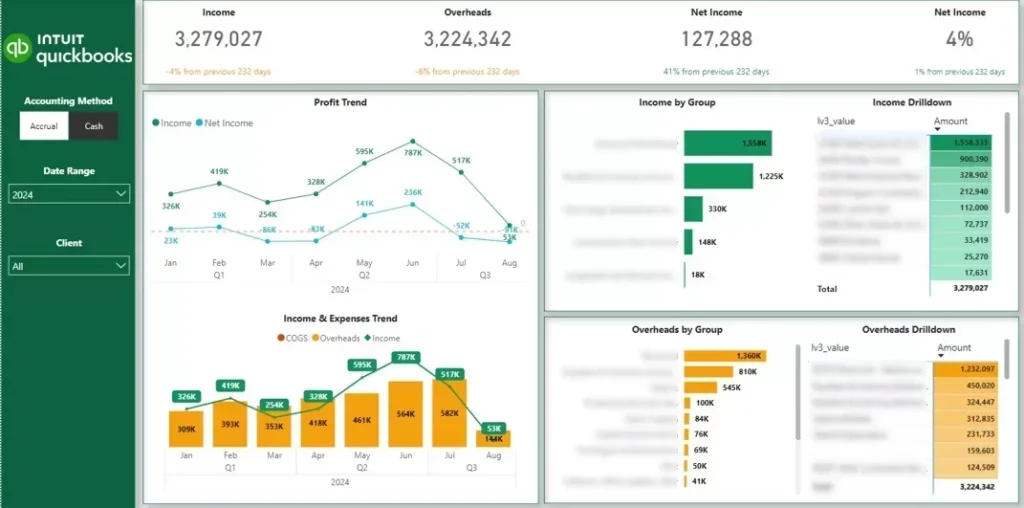
We built the above Shopify ecommerce template for a merchant with a large product catalogue who struggled to decide which products to promote, bundle, or phase out. While revenue was stable, average order value and repeat purchases were below benchmarks.
The dashboard summarises product-level performance by showing how many customers purchased each item, how often they reordered, and the average time between purchases. Selecting a product dynamically filters monthly order trends, making it easy to spot growth patterns and seasonality.
Alongside that, we handle reporting, which is the ongoing rhythm of turning raw activity into something readable. We set up automated reports that land in your inbox or refresh on their own, so you are not manually rebuilding the same summary every week. This is often the quiet win for small teams, because it hands back hours that were being spent on copy and paste.
The part that makes all of this work is the data connectors. We link your existing tools, things like QuickBooks, HubSpot, Shopify, your CRM, or your bank feeds, so the numbers flow in automatically and stay current. You keep using the software you already know, and we take care of getting it to talk to everything else.
And when you want a steer rather than a build, there is analytics consulting. Sometimes you do not need another dashboard; you need someone to sit with you, look at what the data is telling you, and help you decide what to do about it. We are happy to play that role, whether it is a one-off conversation or a regular check-in.
We try to keep this simple, because most small businesses do not have time for a drawn-out procurement process. It usually starts with a short call where we understand what you are trying to see and where your data currently lives, and from there we scope a piece of work with a clear price so you know exactly what you are committing to.
From there you can go one of two ways. Some clients want a defined project, where we build the dashboards and connectors, hand everything over, and show your team how to use it. Others prefer an ongoing arrangement, where we look after the reporting month to month so it stays accurate and evolves as the business changes.
There is no minimum size we insist on and no long lock-in. You can start with something small, see whether it earns its place, and grow the work from there if it does. We would rather prove the value on a focused piece first than ask you to bet big before you have seen what it does for you.
Choosing the right analytics tool can make or break your data strategy. For small businesses, affordability, ease of use, and integration with existing systems are critical.
Here’s a deep dive into two standout platforms, Power BI and Looker Studio, and how they empower small teams to turn data into decisions.
| Microsoft Power BI | Looker Studio | |
|---|---|---|
| Best for | Businesses already working inside the Microsoft ecosystem (Excel, Azure, Teams) that want advanced analytics without needing to code. | Businesses that want an easy, free tool for collaboration and real-time reporting, especially those already using Google services. |
| Pricing | Starts at $10 per user per month (Power BI Pro), with a free version for basic use. | 100% free, though Google monetises it through paid connectors to other data sources and Big Query database fees. |
| Integrations | Connects seamlessly with other Microsoft tools like SharePoint and OneDrive in many different ways, plus over 250 native connectors to outside data sources. | Native integration with Google Analytics, Search Console, Ads, and Sheets, pulling live data straight from each. |
| Dashboards | Drag-and-drop interface with AI-powered insights that automatically detect patterns like seasonal sales trends or outliers. | Customisable drag-and-drop widgets for charts, tables, and maps, though more limited than Power BI for detailed visualisations. |
| Collaboration | Share live dashboards with stakeholders through Teams or email. | Share reports by link with edits visible instantly, and it makes external sharing with investors or customers much easier. |
| Worth noting | The strongest choice when your data and daily tools already live in Microsoft. | Widely used in marketing analytics, so worth considering if that is your main focus. |
Small Business data analytics consulting is all about efficiency and finding the easiest way to achieve the analysis that you need. The good news is that most small businesses have similar data analytics needs so the analysis you need has likely been created before. We have a few actionable tips that follow from this principle below.
Let’s imagine you work in an SME and you want to analyse data from QuickBooks Online. In this case, find a company or a freelancer with a proven record of creating this analysis. They will likely have some files that you can re-use to create the analysis that you need more efficiently. They would also know the data model very well helping them produce the analysis that you need faster.
When you are selecting a consultant for small business data analytics, ask them questions like:
There are many pre-made templates in Power BI, Tableau and Looker Studio for all kinds of data sources. Those are pre-created dashboards that already have all the formulas that you need to make the numbers match. As a result you can use these templates to get started quickly and customise them later.
Starting from a pre-made template saves you time having to develop the analysis from scratch and allows you to achieve more for the same budget.
If you want to automatically extract data from certain data sources you have 2 options:
Coding an integration from scratch takes a lot of working hours which you need to pay for. As a result, this is often too expensive for most SMEs. It is therefore often more affordable to pay for a data connector that helps you automate data extraction.
As a rule of thumb, buying ready-made solution would be more cost efficient than developing them from scratch.
Based on our experience in small businesses data analytics consulting, the following data sources are most common to analyse.
SMEs have most of their data on Excel since many are trying to avoid additional software costs. The data on these spreadsheets can be related to pretty much anything.
We often see client billing data being stored on Excel in SMBs since many record weekly sales on spreadsheets before sending invoices to clients.
Excel might also contain data grouping for items into categories. Those mapping tables would be brought into data analytics reports like Vlookups.
Financial data analytics is a treasure trove of insights into profitability, cash flow, and spending patterns.
Accounting analytics is focused around:
The data analysis from marketing platform is usually focused around finding the most efficient customer acquisition channel.
Marketing analytics is usually focused around:
Your online store holds clues about customer behavior, product popularity, and sales bottlenecks.
E-commerce analytics is focused around
These platforms track team’s productivity, project timelines, and resource allocation—critical for scaling efficiently.
Project Management Analysis is focused around:
KPIs are performance indicators that show how effectively a company achieves its long term objectives. For instance, KPIs can include sales growth, customer retention rate, employee turnover etc. The first step to small business data analytics is identify KPIs, the data to calculate those KPIs and also the most effective way to visualise them.
There are 3 possible approaches:
Once the data is available, the next step is to develop a data analytics report that will provide real-time insights, allowing businesses to monitor its performance. A data analyst would use different charts to ensure that a report is developed in a clear and visually appealing way.
The data analysts usually schedule a call with the business managers to discuss results and all the limitations of the analytics report. Sometimes additional analysis is required after such meetings. All parts of the completed analysis are critically evaluated.
The data analysts in small businesses then maintain, ensuring the dashboards are updated as new data sources are added, business needs or data format change. It is vital that the report will answer business questions over time, not just once.
If you need a reliable partner for your small business data analytics needs, reach out to us today! We have successfully delivered 1000+ projects for 600+ international clients so we have a significant amount of experience to bring into your projects.
Because of our experience we also have many files which we can re-use to deliver the project more efficiently. This enables us to spend less working hours on your data analysis projects delivering them cheaper and faster than competitors.
Finally, we have our own software for data extraction which helps us extract the data for our clients quickly and efficiently.
Most of our work is priced per project once we understand the scope, though day rates and fixed monthly retainers are also common depending on how you prefer to budget. A focused piece of work like a single dashboard or a data audit usually sits in the low thousands, while a larger platform build or an ongoing managed reporting arrangement will cost more because it involves more people and time. We are happy to give you a clear estimate up front so there are no surprises later.
We build business intelligence and reporting solutions, mostly around Power BI, alongside Power Platform development, API integrations, and workflow automation. We also take on managed reporting, where we look after your dashboards and data pipelines on an ongoing basis so your team does not have to. Whether you need a one-off build or a long-term partner, we can shape the engagement around what actually helps you.
It usually is when you need specialist skills you do not have in-house or when a project keeps slipping down the priority list because everyone is already stretched. The honest trade-off is cost, since a good consultant is not cheap, but you are paying for speed and experience rather than learning everything from scratch. If the work is genuinely core to your business and ongoing, hiring internally may make more sense over time, and we will tell you when that is the case.
An employee is the right call when the work is constant and central to how you operate, though it comes with recruitment time, salary, and management overhead. A freelancer is flexible and often cheaper for short bursts of work, but you carry more risk if they are unavailable or move on mid-project. An agency like us costs more than a single freelancer but gives you a team, continuity, and a broader range of skills, which tends to matter most on anything complex or business-critical.


