

Robotic Process Automation (RPA) is transforming how businesses operate by automating repetitive, rule-based tasks with precision and speed. Organisations across finance, healthcare, retail, and public sectors are increasingly turning to RPA Companies to streamline operations, reduce costs, and enhance productivity.
Choosing the right RPA consulting partner is critical. The best firms not only implement automation tools but also provide strategic guidance, scalability, and long-term support.
In this article, we explore the benefits of working with a professional provider of custom RPA solutions and highlight the Top 10 RPA consulting companies.
Robotic Process Automation (RPA) is a technology that uses software robots, or “bots,” to automate repetitive, rule-based tasks typically performed by humans. These tasks can include data entry, invoice processing, report generation, and moving information between systems.
RPA works by mimicking human interactions with digital systems, such as clicking, typing, and reading data from applications. It does not require changes to existing IT infrastructure, making it a fast and cost-effective way to improve efficiency.
By implementing RPA, businesses can reduce errors, save time, and allow employees to focus on more strategic and value-driven activities. Many of whom supplement their skills with an artificial intelligence course to better collaborate with automated systems.
Partnering with experienced RPA Companies offers several advantages:
1. Increased Efficiency
RPA eliminates manual, repetitive tasks, allowing teams to focus on higher-value work. Processes that once took hours can be completed in minutes.
2. Cost Reduction
Automation reduces operational costs by minimising human error and lowering labour requirements for routine tasks.
3. Improved Accuracy and Compliance
RPA bots follow predefined rules, ensuring consistent results and better compliance with regulations—especially important in industries like finance and healthcare.
4. Scalability
RPA solutions can easily scale as your business grows, handling increased workloads without significant additional investment.
5. Faster ROI
Many organisations see a return on investment within months due to productivity gains and cost savings.
6. Enhanced Customer Experience
Automation speeds up service delivery, reduces errors, and improves response times, leading to better customer satisfaction.
Vidi Corp is a leading name among RPA consulting companies, known for delivering intelligent automation solutions tailored to business needs. As one of the top RPA companies on Clutch, we have built a strong reputation by helping organisations move beyond basic automation and adopt truly transformative digital workflows. Rather than offering one-size-fits-all solutions, Vidi Corp takes a consultative approach, analysing each client’s processes, identifying automation opportunities, and designing customised RPA strategies that align with long-term business goals.
Vidi Corp’s expertise spans multiple industries, including finance, healthcare, logistics, and retail, allowing it to deliver industry-specific automation solutions that address real-world challenges. Their end-to-end services cover everything from process discovery and bot development to deployment, monitoring, and ongoing optimisation.
Key strengths:
Ideal For
Website : https://vidi-corp.com/
Best for: Platform-based governance and multi-country rollouts.
Capgemini stands out for its ability to unify AI, RPA, and analytics into a single, cohesive platform. This “platform-based governance” approach allows large enterprises to standardize operations across international borders, ensuring decision-making consistency and process reliability .
By integrating comprehensive telemetry and monitoring into their solutions, Capgemini helps clients achieve “repeatability and data-driven optimization,” making them an ideal partner for organizations seeking to harmonize disparate global operations
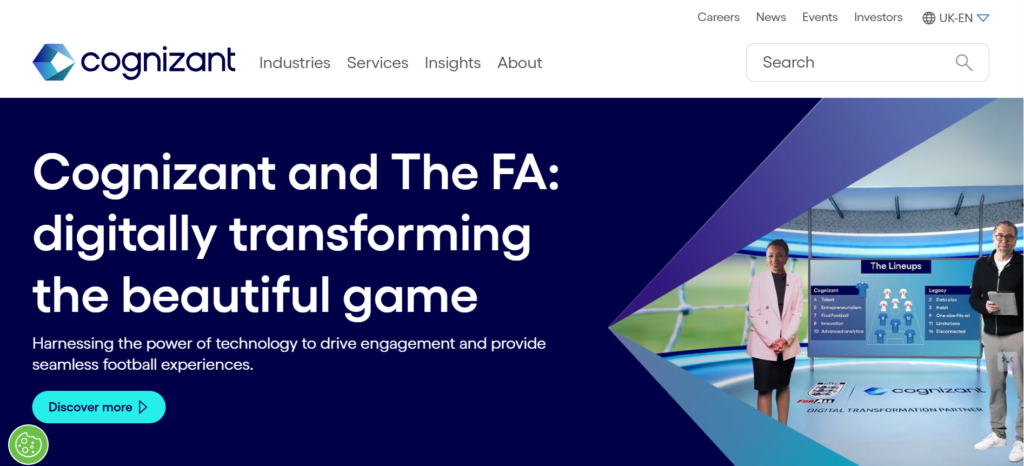
Best for: Cultural change management and “embedded” consulting.
Recognized as a leader in the 2026 market, Cognizant offers a unique “embedded expert” model. Rather than simply implementing technology and leaving, Cognizant integrates its consultants deeply within client teams to manage the cultural and organizational shifts that automation requires.
This approach is particularly effective for companies facing internal resistance to new technology or those needing help coordinating automation across siloed departments. Their focus on holistic change management helps clients transition from experimental phases to enterprise-wide deployment smoothly
Best for: European enterprises seeking premium tech-native consulting.
Devoteam has made aggressive moves to solidify its leadership in intelligent automation. In January 2026, the firm announced the acquisition of Infinity, a French RPA and digital automation lab. This strategic move was aimed at accelerating Devoteam’s “Hyperbots” offering—a unique combination of RPA and generative AI .
This acquisition enriches Devoteam’s expertise in process mining and agentic automation, positioning them as a premier player across EMEA. For European enterprises looking for a tech-native partner with deep local expertise and cutting-edge AI capabilities, Devoteam is a top contender
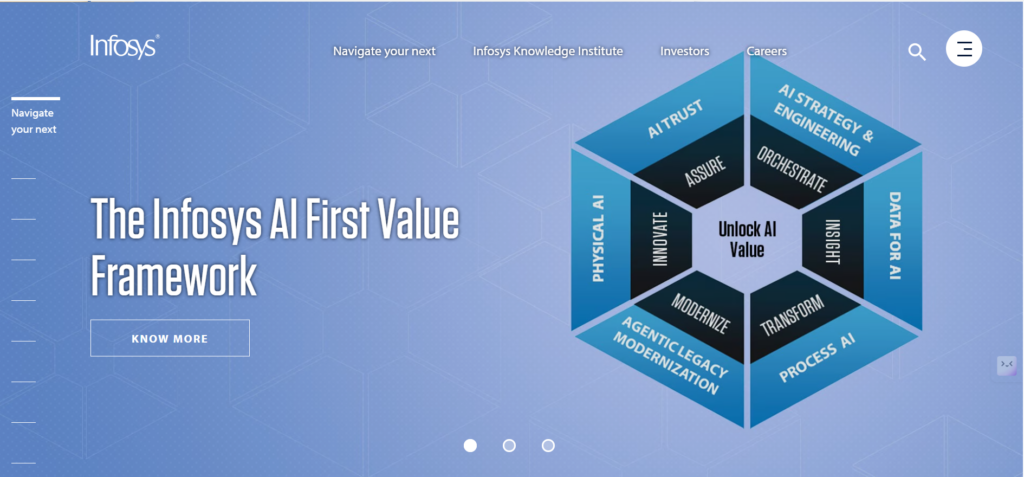
Best for: End-to-end services and cost-efficient scalability.
Infosys is a perennial leader in the global IT services landscape and a major player in the RPA consulting market. They offer a full spectrum of services, from consulting and strategy to development and managed services. According to market reports, Infosys is consistently listed among the top global producers of RPA consulting and development services .
Their strength lies in their ability to deliver high-volume, cost-effective automation solutions for large-scale enterprises, often integrating RPA with broader digital transformation initiatives.

Best for: Large-scale industrial and manufacturing automation.
TCS leverages its deep roots in industrial sectors to deliver robust automation solutions that bridge the gap between IT and operational technology (OT). Like Infosys, TCS is a dominant force in the global strategic market for business process automation, with a strong presence in manufacturing, retail, and BFSI .
TCS excels at using RPA and AI to modernize legacy systems and optimize end-to-end workflows, making them a reliable partner for established enterprises with complex, mission-critical processes .
Nintex offers a comprehensive workflow automation platform focused on simplifying business process management through no-code and low-code tools. It enables organisations, especially those using Microsoft environments, to automate workflows, document generation, process mapping, integrations, and RPA.
Serving industries like healthcare, government, financial services, and education, Nintex stands out for its strong Microsoft integration, user-friendly workflow builder, and rapid deployment capabilities. It is particularly well-suited for mid-sized businesses and Microsoft-centric organisations.
Kissflow is a cloud-based workflow automation platform designed to help organisations automate processes without requiring deep technical expertise. Its no-code tools allow business users to quickly build workflows, manage processes, and automate forms and integrations.
Serving industries such as IT, manufacturing, retail, and finance, Kissflow is known for its intuitive interface, fast deployment, and cost-effective pricing.
It is especially ideal for small to mid-sized businesses and non-technical teams looking for simple, scalable automation solutions.
WorkFusion specialises in AI-powered automation for highly regulated industries like banking and insurance, combining RPA, machine learning, and advanced data processing to handle complex, document-heavy workflows.
Its services include robotic process automation, AI-driven document processing, data extraction, and compliance automation.
Known for its strong AI capabilities and focus on regulatory environments, WorkFusion is particularly well-suited for financial institutions and organisations with heavy compliance requirements.
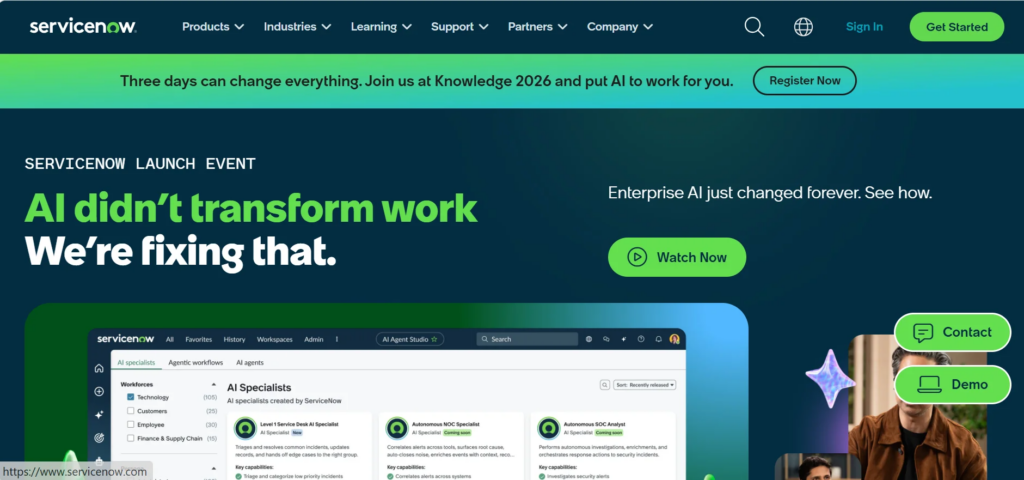
ServiceNow has evolved from an IT service management tool into a powerful workflow automation platform that serves as a digital backbone for enterprise operations. Its Now Platform enables automation across IT, employee, and customer workflows using RPA, AI, document processing, and integration capabilities.
Serving industries such as technology, finance, healthcare, manufacturing, and the public sector, ServiceNow stands out for its unified platform, strong ITSM foundation, advanced AI features, and extensive ecosystem.
It is ideal for organisations seeking a single, enterprise-wide solution to streamline and automate service workflows across both IT and business functions.
Jitterbit is an enterprise integration and workflow automation platform that combines iPaaS, API management, low-code app development, and AI-driven orchestration through its Harmony platform.
It enables end-to-end automation by simplifying complex system integrations and workflows. Serving industries like manufacturing, retail, healthcare, technology, and financial services, Jitterbit stands out for its integration-first approach, unified toolset, and AI-powered design capabilities.
It is particularly ideal for mid-market and enterprise organisations looking to connect multiple systems and streamline data-driven workflows.
Microsoft Power Automate is a cloud-based automation platform that enables businesses to streamline workflows and automate repetitive tasks across applications and services. As part of the Microsoft Power Platform, it allows users to create automated processes with minimal coding through an intuitive interface. From simple task automation to advanced robotic process automation (RPA) with desktop flows, Power Automate helps organisations improve efficiency, reduce manual effort, and integrate seamlessly with both Microsoft and third-party applications. For a sense of what you can build with it, browse our Power Automate examples covering cloud, desktop, and AI flows.
Key Features
Advantages
Limitations
Zapier is a popular no-code automation platform that allows users to connect apps and automate workflows without any programming knowledge. By creating simple “Zaps,” users can trigger actions between thousands of applications such as Slack, Gmail, and Shopify.
Key Features
Advantages
Limitations
Automation Anywhere is a leading cloud-native automation platform that enables organisations to automate complex business processes using Robotic Process Automation (RPA) combined with AI and analytics. Its cloud-first architecture allows businesses to deploy, manage, and scale automation quickly without heavy infrastructure. Designed for enterprise use, Automation Anywhere supports end-to-end automation, from simple task automation to intelligent, cognitive workflows.
Advantages
Limitations
Blue Prism is an enterprise-grade RPA platform and one of the pioneers in the digital workforce space. Designed for large organisations, it enables businesses to automate complex, rule-based processes with high levels of security, scalability, and governance. Blue Prism’s platform allows companies to deploy software robots that work alongside human teams, improving efficiency and operational accuracy across critical business functions.
Advantages
Limitations
UiPath is a market-leading RPA platform widely recognised for its extensive automation capabilities and user-friendly design. It enables organisations to automate everything from simple repetitive tasks to complex, end-to-end business processes using a combination of RPA, AI, and machine learning. With a strong presence in the UK and globally, UiPath is trusted by enterprises to drive digital transformation and improve operational efficiency.
Advantages
Limitations
The demand for RPA Companies continues to grow as businesses seek efficiency, scalability, and digital transformation. From giants like Capgemini to specialised firms like Vidi Corp, organisations have a wide range of options to choose from.
Selecting the right RPA partner depends on your business goals, industry requirements, and scalability needs. With the right consulting company and software platform, RPA can become a powerful driver of innovation and competitive advantage.


