

Higher education institutions generate vast amounts of data, but turning that data into meaningful insight remains a challenge. Business Intelligence helps colleges and universities bring academic, operational, and engagement data together to support better decisions and measurable outcomes.
At Vidi Corp, we have worked with universities like Stanford and Imperial College London to design BI solutions that move beyond static reports. Our experience spans academic performance tracking, attendance monitoring, marketing analytics, financial reporting, and inclusion-focused dashboards, all built to support real decision-making.
In this article, we explain what Business Intelligence means in a higher education context, why it matters, and how it is applied in practice. We also share real-world BI use cases, key benefits for institutions, and common challenges to consider when implementing BI at scale.
Business Intelligence (BI) in higher education refers to the use of data, reporting, and analytics tools to support better decision-making across colleges and universities. It brings data together from systems like student information, learning platforms, finance, and admissions to create a clear, shared view of performance.
Instead of working with disconnected reports, BI helps institutions understand what is happening across academics, operations, and finance in one place. Leaders can track trends, spot issues early, and make informed decisions based on reliable data rather than assumptions.
In practice, BI in higher education is commonly focused on four core areas. Strategy analytics tracks progress against institutional goals, attendance analytics monitors student engagement, marketing analytics measures recruitment and application performance, and financial analytics provides visibility into revenue, costs, and funding efficiency. Together, these insights help institutions improve outcomes, allocate resources more effectively, and plan with confidence.
Business Intelligence plays a critical role in helping higher education institutions make better decisions. It gives leaders and administrators a shared understanding of performance across academics, operations, and finance.
One of the biggest benefits of BI is its impact on student success. By analysing data on attendance, engagement, and performance, institutions can identify trends early, spot at-risk students, and provide targeted support before problems escalate.
BI is also essential for strategic planning and resource allocation. Universities can evaluate the effectiveness of programs, optimise budgets, and ensure resources are invested where they deliver the most value.
Finally, BI enables evidence-based decision-making across the institution. With reliable data to guide policy changes and long-term planning, higher education organisations can adapt to changing demands while improving operational efficiency and educational outcomes.
The examples below show how our data visualization consultants applied business intelligence in practice across key areas such as academic performance, attendance, marketing, finance, DEI, and student engagement. If any of those look relevant, you can ask our consultants to build a similar dashboard for your organization!
Student success analytics helps institutions evaluate student outcomes by combining assessment results with attendance and support data.
In the case study below, we worked with a public school district to analyze academic performance across schools, particularly in literacy and math. While performance data, absenteeism records, and special education information were available, analysing these datasets together to identify patterns and risks was difficult and time-consuming.
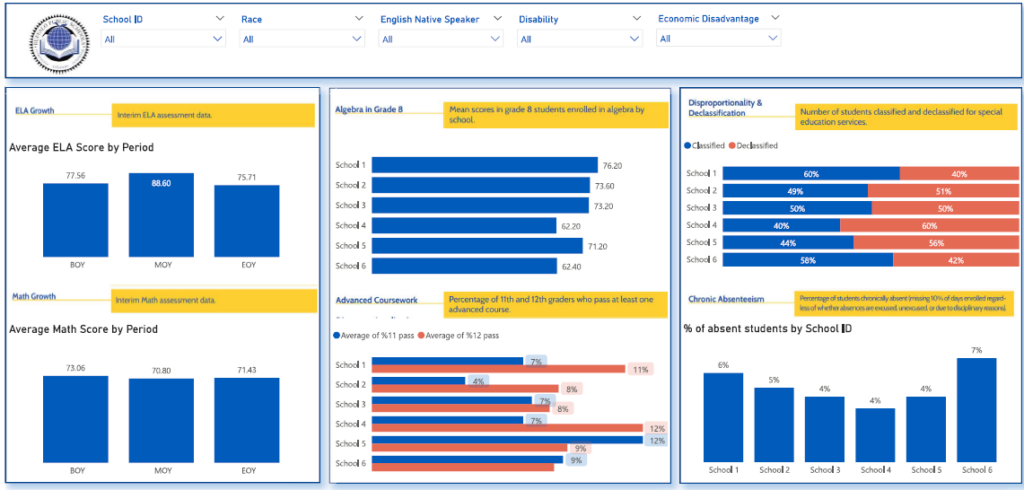
We designed an academic performance dashboard to measure student results in literacy and math assessments by school. Additional tabs analysed absenteeism trends and special education needs, enabling side-by-side comparison across schools and student groups.
The dashboard allowed leaders to identify performance gaps, schools with elevated absenteeism, and areas where additional special education support was required. By viewing academic results alongside attendance and support needs, the institution gained a more complete picture of student outcomes, enabling earlier intervention, better resource planning, and more effective support strategies across the district.
Attendance Analytics helps institutions monitor student engagement by tracking presence and absence at lectures and sessions. In a real-world implementation, the university used QR codes to record attendance, requiring students to scan a code before each lecture. While this approach captured detailed data, the institution needed a more reliable way to analyse attendance patterns and identify disengagement early.
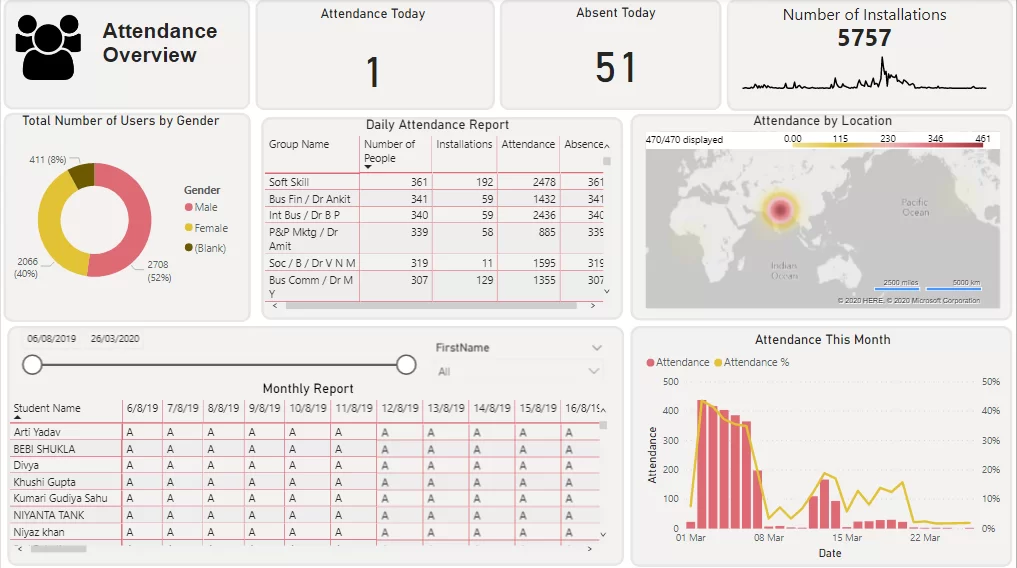
Our Power BI consultants analysed student attendance and absences on a daily basis. At a group level, the dashboard showed total students per group, how many had installed the attendance app, monthly attendance counts, and recorded absences.
At the student level, the report displayed daily attendance status using simple indicators for presence and absence, with the ability to filter by date range and student name. Users could also export attendance records to Excel for further analysis or reporting.
The dashboard enabled staff to monitor attendance in near real time and quickly identify groups or individual students at risk of disengagement. By automating attendance reporting and combining group-level and student-level insights, the university improved oversight, supported earlier interventions, and reduced manual reporting effort.
Marketing Analytics helps higher education institutions understand how prospective students and families discover and engage with their digital channels. In this engagement, we worked with a community college that needed clearer visibility into the performance of its marketing efforts and the effectiveness of its website in attracting local audiences.
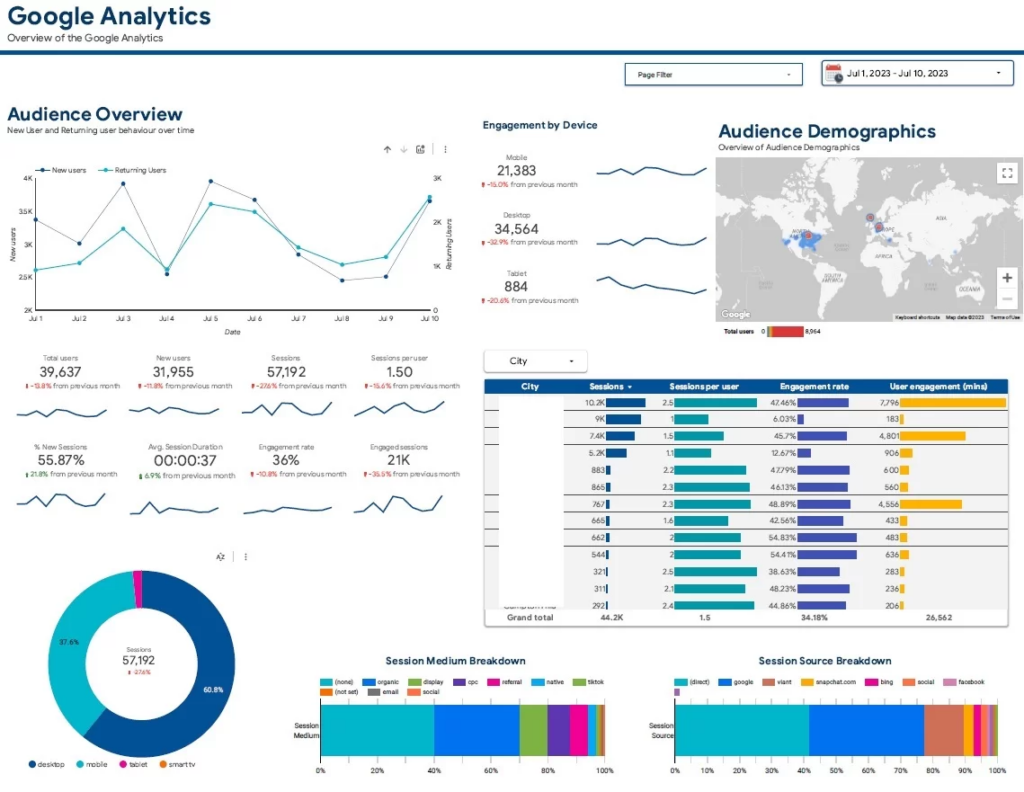
Our Google Tag Manager consultants set up tracking of online events in Google Analytics 4 (GA4) and visualised the data in Looker Studio.
The first page of the dashboard measured total website users and analysed where they came from. Since the college primarily targeted local families, we visualised website visitors by city to identify how many relevant visitors the marketing team managed to drive to the website. Session source and medium analysis highlighted the most effective channels driving traffic to the website.
The dashboard gave the marketing director a clear view of which locations and channels delivered the highest engagement. These insights helped refine targeting, optimise marketing spend, and focus efforts on the sources that most effectively reached prospective students and their families.
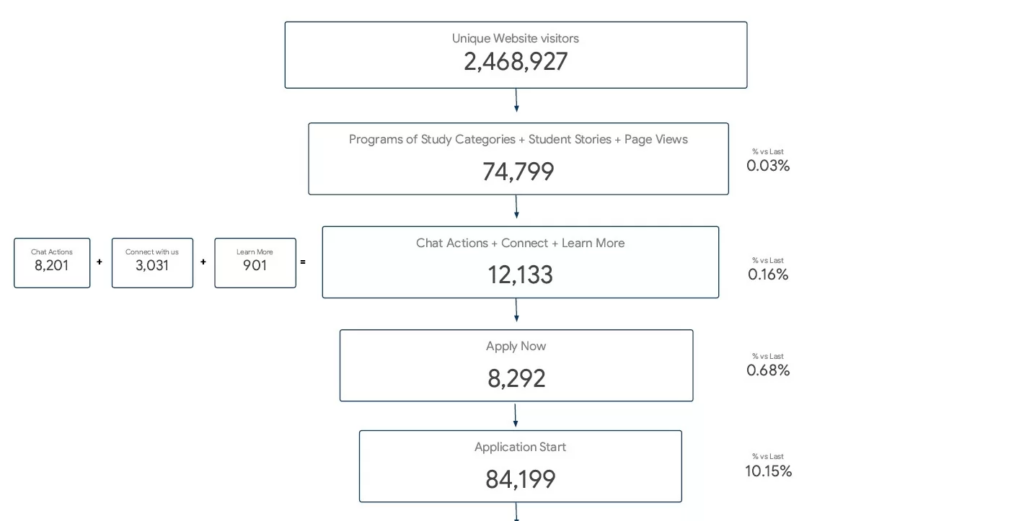
Our marketing analytics consultants also analysed the college’s marketing funnel to assess how effectively website visitors convert into applications. The top of the funnel focused on traffic to key student experience and course pages, while the middle of the funnel highlighted micro-conversions such as enquiries and “learn more” interactions.
At the bottom of the funnel, the analysis tracked application starts and completions, helping the college identify drop-off points and opportunities to improve conversion performance across the journey.
Financial Analytics helps higher education institutions understand the financial performance of their programs, campuses, and student population. We recently worked with the CFO of a university in Norway who needed a clearer view of financial outcomes across the institution.
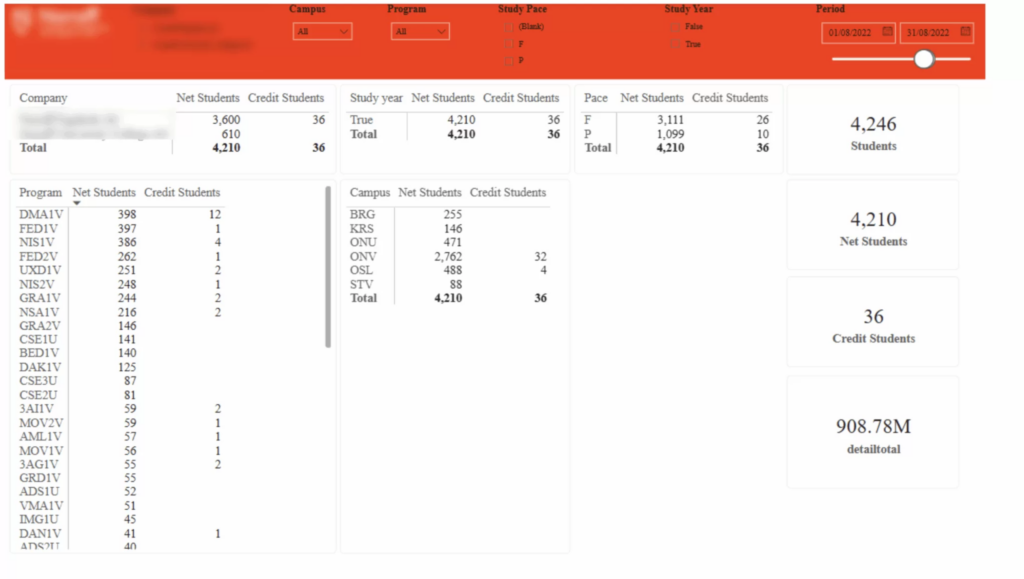
Our Power BI developers built a dashboard using data from Salesforce CRM and a SQL database that stored financial records. The dashboard analysed the total number of enrolled students, broken down by program and campus, providing visibility into how revenue and enrolment were distributed across the university. We also analysed students who had been issued credit notes, highlighting cases that required special financial management.
The dashboard enabled finance leadership to quickly identify trends in enrollment, monitor financial exceptions, and better understand the financial impact of different programs and campuses. These insights supported stronger financial planning, improved oversight of special cases, and more confident, data-driven decision-making at the executive level.
Behaviour and Workforce Diversity Analytics helps institutions monitor disciplinary trends and align hiring practices with the demographics of their student population. In this example, the institution wanted to ensure the same level of diversity between their students and staff.
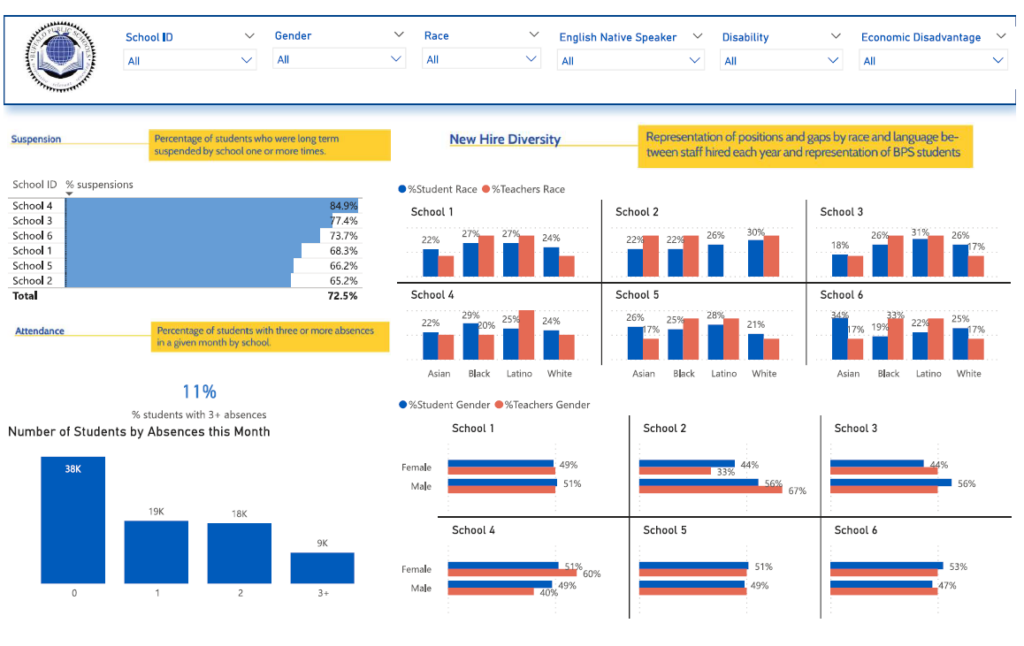
We developed a dashboard that analysed suspension rates across different student groups, highlighting where suspension percentages were highest. The final tab of the report also measured new hire diversity, comparing recruitment outcomes against the school’s overall demographic distribution.
The dashboard enabled leadership to identify student groups most affected by suspensions and design targeted interventions to reduce disciplinary actions. At the same time, HR teams gained clear visibility into how well hiring practices aligned with diversity goals. Together, these insights supported fairer disciplinary policies, more inclusive hiring decisions, and stronger alignment between student and staff demographics.
Extra-Curricular activities engagement analytics helps institutions understand how students and their families participate in activities outside the classroom, such as clubs, sports, and enrichment programs.
In the case study below, the institution needed clearer visibility into how engagement differed across demographic and socioeconomic groups. While participation data was available, it was fragmented and made it difficult to identify underrepresented students or track how engagement evolved throughout the academic year.
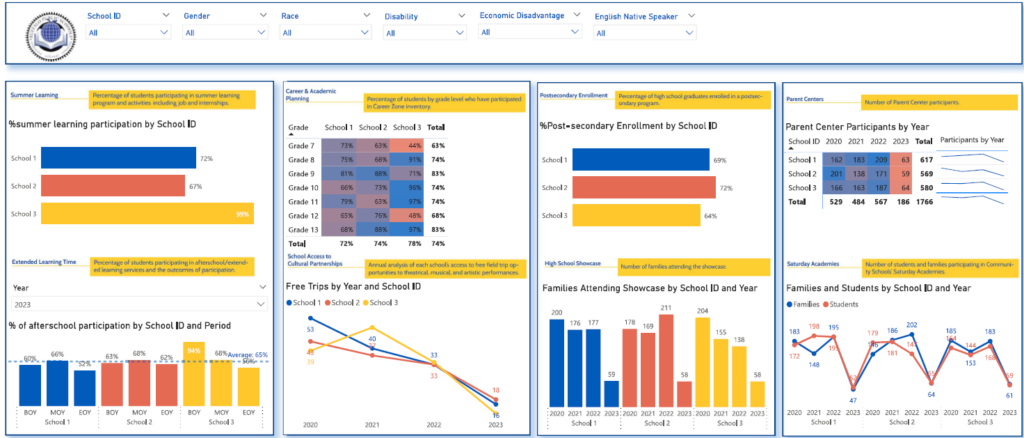
Our team created a BI dashboard that brought extra-curricular activity data into a single view and applied filters for protected characteristics such as age, gender, disability, and economic disadvantage. Key KPIs were displayed for Beginning of Year (BOY), Middle of Year (MOY), and End of Year (EOY), allowing users to track changes in participation and identify emerging gaps over time.
Our dashboard enabled staff to quickly pinpoint student groups requiring additional support and evaluate the effectiveness of inclusion initiatives throughout the year. By comparing beginning, middle and end of year performance, the institution gained clear evidence to guide funding decisions, refine programs, and improve overall engagement and equity.
Business Intelligence helps higher education institutions make better use of their data across academics, operations, and planning. Below are the key benefits of using Business Intelligence in higher education institutions.
BI enables leaders to base decisions on up-to-date data rather than assumptions. Dashboards provide real-time visibility into key areas such as enrollment, attendance, academic performance, and finances, supporting more confident and timely decisions at every level.
With access to detailed performance and engagement data, institutions can identify students at risk earlier and intervene proactively. By analysing trends in attendance, assessments, and behaviour, BI supports targeted academic support, improved retention, and better overall student success.
BI helps institutions understand where resources deliver the most value. By analysing program performance, staffing levels, and operational costs, universities can allocate budgets more effectively and avoid underutilisation or unnecessary spend.
Automated data collection and reporting reduce manual effort across departments. Instead of relying on spreadsheets, staff can access consistent dashboards, saving time and reducing the risk of errors.
BI tools allow institutions to build dashboards tailored to their specific needs, whether for academic teams, finance, marketing, or leadership. Reports can be securely shared across departments, ensuring everyone works from the same version of the data and improving collaboration.
By analysing historical trends, BI supports forward-looking planning. Institutions can forecast enrollment, anticipate demand for courses, and identify potential retention risks, enabling proactive planning.
While Business Intelligence delivers significant value, implementing it in higher education comes with a set of challenges that institutions need to plan for. Below are the most common considerations when adopting BI across academic and operational environments.
Higher education data often sits across multiple systems, such as student information systems, learning platforms, finance tools, and CRM solutions. Inconsistent data definitions, missing records, and poor data quality can limit the reliability of BI insights if not addressed early.
Institutions handle sensitive student and staff data, making privacy and security a critical concern. BI implementations must comply with data protection regulations and ensure that access to reports is tightly controlled based on user roles.
Even well-designed dashboards can fail if users are not aligned or trained. Staff may be accustomed to spreadsheets or manual reports, so adoption requires clear communication, stakeholder involvement, and ongoing support.
BI platforms depend on reliable data pipelines and underlying infrastructure. Institutions must ensure their systems can support automated refreshes, growing data volumes, and future reporting needs without performance issues.
Business Intelligence is no longer a nice-to-have in higher education. It has become a critical capability for institutions that want to improve student outcomes, operate more efficiently, and make decisions based on evidence rather than assumptions.
As the examples in this article show, BI can be applied across academic performance, attendance, marketing, finance, inclusion, and student engagement. When data is brought together into clear, accessible dashboards, leaders gain the visibility they need to act early, allocate resources effectively, and plan with confidence.
For institutions exploring Business Intelligence or looking to improve existing reporting, the next step is understanding which use cases matter most and how your data can support them. Contact us today to discuss how Business Intelligence can be tailored to your institution and start building reporting that supports better decisions!


